

When a toddler is not talking as much as expected, is difficult to understand, or seems to struggle with understanding language, finding the right toddler speech pathologist can feel like an important first step. Parents in Canada often have questions about what an S-LP does, when an assessment is appropriate, how services work, and whether they should wait for their child to “catch up.”
The good news is that parents do not need to diagnose a speech or language disorder themselves. A speech-language pathologist (S-LP) can assess communication skills, identify areas of strength and difficulty, explain what the findings mean, and recommend practical next steps. Speech-language pathologists in Canada work with communication and swallowing concerns across the lifespan, including speech, language, fluency, voice, and feeding-related concerns. (SAC-OAC)
This guide explains what Canadian parents should know before choosing a toddler speech pathologist, while keeping the focus on practical, evidence-informed information rather than promises about outcomes.
What Is a Toddler Speech Pathologist?
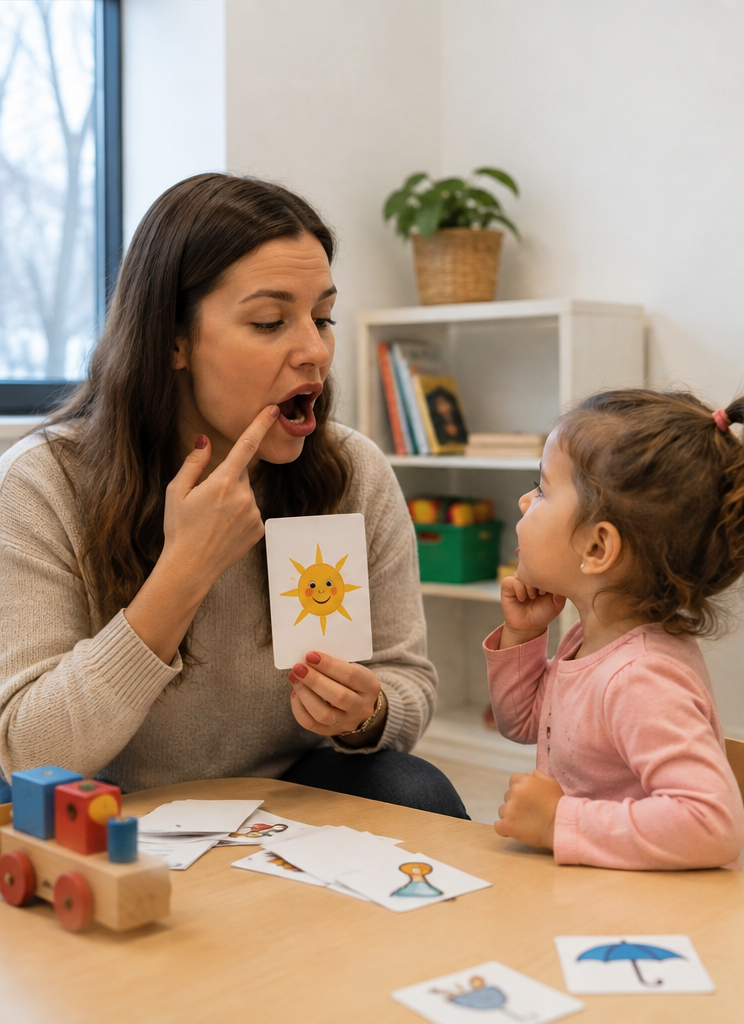
A toddler speech pathologist is a speech-language pathologist who assesses and supports young children with communication concerns. They may help with understanding language, using words and sentences, speech sounds, social communication, fluency, and some feeding or swallowing difficulties. They also coach parents on communication strategies that fit naturally into everyday routines.
Table of Contents
- What Does a Toddler Speech Pathologist Do?
- When Should a Toddler See a Speech Pathologist?
- Toddler Speech and Language Milestones
- Speech Delay vs. Language Delay
- Why Early Assessment Can Be Helpful
- What Happens During a Toddler Speech Assessment?
- How Toddler Speech Pathologist Therapy Works
- Parent Coaching and Home Practice
- Bilingual and Multilingual Toddlers in Canada
- How to Choose a Toddler Speech Pathologist in Canada
- Public and Private Speech-Language Services in Canada
- Questions to Ask Before Starting Therapy
- A Practical Checklist for Canadian Parents
- People Also Ask
- Q&A: Expert Questions About Toddler Speech Pathologists
- Conclusion
What Does a Toddler Speech Pathologist Do?
A toddler speech pathologist is a regulated health professional in Canadian jurisdictions where speech-language pathology is regulated. The professional’s role is broader than simply teaching a child to pronounce words.
Speech-language pathologists can assess and treat communication disorders involving speech and language. They may also work with swallowing and feeding concerns, depending on their training, competence, and scope of practice. (SAC-OAC)
For a toddler, an assessment may consider several areas:
- Receptive language: what the child understands.
- Expressive language: how the child communicates ideas, needs, and experiences.
- Speech production: how the child produces speech sounds.
- Social communication: how the child uses communication with other people.
- Gestures and non-verbal communication: pointing, showing, waving, eye gaze, facial expressions, and other communication behaviours.
- Play and interaction: how communication develops during play and everyday activities.
- Fluency: whether speech has unusual repetitions, prolongations, or blocks.
- Feeding or swallowing: when this falls within the clinician’s scope and the child’s needs.
Importantly, a toddler does not need to be able to sit through a long conversation for an assessment to be useful. Young children are often assessed through play, interaction, observation, parent interviews, structured activities, and age-appropriate assessment tools.
The purpose is not simply to count words. A qualified toddler speech pathologist looks at the broader communication picture.
When Should a Toddler See a Speech Pathologist?
There is no single “magic age” when every parent should seek an assessment. However, concerns are worth discussing when a child’s communication seems significantly different from what is expected for their age or when parents, caregivers, or health professionals notice persistent difficulties.
Examples of reasons to consider an assessment include:
- Your toddler uses very few spoken words.
- Your toddler is not combining words when expected.
- Your child seems to understand much less language than other children of a similar age.
- Your toddler has stopped using communication skills they previously had.
- Family members have difficulty understanding your child’s speech.
- Your child rarely communicates through gestures, sounds, words, or other means.
- Your toddler becomes frustrated because communication is difficult.
- Your child has difficulty participating in everyday interactions.
- You have concerns about feeding, chewing, swallowing, or mealtimes.
- You simply feel that something about communication is not developing as expected.
A concern does not automatically mean that a child has a disorder.
Children develop at different rates, and communication is influenced by many factors. However, an assessment can replace uncertainty with useful information.
For example, Ontario’s Preschool Speech and Language Program allows families to access services for children from birth until school entry when they have concerns about speech or language development. The program states that a doctor’s referral is not required to register. (Ontario)
Programs and access routes vary across Canada, so parents should check the services available in their province or territory.
Toddler Speech and Language Milestones
Milestones can help parents understand communication development, but they should not be treated as a pass-or-fail test.
For example, HealthLink BC describes a range of language skills that can develop between 18 and 24 months. These include using words to communicate, copying words and phrases, naming pictures, asking for help, and beginning to combine words. (HealthLink BC)
By approximately 30 to 36 months, HealthLink BC describes toddlers as increasingly using sentences, asking and answering questions, talking about events, using social words, and understanding more complex directions. (HealthLink BC)
These examples illustrate why age matters when evaluating communication.
A toddler who says fewer words at 18 months is not necessarily experiencing the same issue as a three-year-old who has difficulty combining words. Similarly, speech clarity develops gradually, so unfamiliar listeners may understand less than parents do.
A toddler speech pathologist considers the child’s age, communication profile, development, environment, strengths, and functional needs rather than relying on one milestone alone.
For Canadian families looking for general communication information, HealthLink BC’s toddler language-development guidance is a useful public-health resource. (HealthLink BC)
Speech Delay vs. Language Delay
The words “speech” and “language” are often used interchangeably in everyday conversation, but they describe different areas.
Speech involves producing sounds and physically communicating spoken words. A speech difficulty might involve particular sounds, sound patterns, fluency, or motor aspects of speech.
Language involves understanding and using a communication system. It includes vocabulary, grammar, sentence structure, comprehension, and the ability to communicate meaning.
For example, a toddler may understand many instructions but use very few words. Another child may talk frequently but have difficulty understanding questions or following directions.
Some children have difficulties in both areas.
This distinction matters because intervention should match the child’s actual communication needs. A toddler speech pathologist may therefore spend time assessing both what a child says and what the child understands.
The distinction is also useful for parents because a child who is “not talking” may have a different underlying communication profile from a child whose speech is difficult to understand.
Why Early Assessment Can Be Helpful
Early assessment does not mean every toddler needs intensive therapy.
Instead, early identification can help families understand what is happening and decide what level of support is appropriate. Ontario’s current preschool speech and language framework, for example, describes a continuum that includes access and intake, early intervention, assessment, intervention, and supportive transitions. (Ontario)
That approach is important because children do not all need the same service.
One toddler might benefit mainly from parent education and monitoring. Another may benefit from targeted intervention. A child with more complex communication needs may require specialized assessment and collaboration with other professionals.
Early support can also give parents practical strategies to use at home.
Rather than asking only, “How many words should my toddler have?”, a better question can be:
“How is my child communicating, what is getting in the way, and what can we do to support communication?”
That shift keeps the focus on the child’s everyday participation.
What Happens During a Toddler Speech Assessment?
Parents sometimes imagine an assessment as a formal test in which a toddler must answer questions correctly.
In reality, assessment can be much more flexible.
A toddler speech pathologist may begin by asking parents about:
- Pregnancy and birth history, where relevant.
- Developmental history.
- Hearing history.
- Medical or developmental information.
- Languages used at home.
- Communication concerns.
- Current words and phrases.
- How the child communicates wants and needs.
- How the child interacts with family members.
- Childcare or preschool observations.
- Previous assessments or services.
The clinician may then observe the child during play.
For example, a toddler might be encouraged to play with toys, look at books, request objects, imitate actions, follow instructions, or interact with a caregiver.
The clinician is watching for patterns.
Can the child understand language? Can they communicate intentionally? Do they use gestures? Do they combine words? How do they respond to another person’s communication? What helps them communicate successfully?
Depending on the child’s age and needs, standardized assessment tools may also be used.
A good assessment should result in an understandable explanation of the findings. Parents should know what the clinician observed, what the child’s strengths are, what areas need support, and what the recommended next steps are.
How Toddler Speech Pathologist Therapy Works
Therapy for toddlers is usually different from traditional “sit at a table and practise” approaches.
Young children learn through interaction and meaningful activities. Therefore, intervention may be built around:
- Play.
- Books.
- Songs and rhymes.
- Mealtimes.
- Dressing.
- Bath time.
- Outdoor activities.
- Pretend play.
- Everyday conversations.
- Turn-taking.
- Following routines.
For example, if a toddler rarely requests items, therapy may focus on creating natural opportunities to communicate during play.
If a toddler has difficulty combining words, the clinician may model short phrases and create situations where the child has a reason to communicate.
If understanding language is difficult, therapy may involve helping the child understand simple directions, concepts, vocabulary, and routines.
The exact approach depends on the child’s communication profile.
There is no single therapy method that is appropriate for every toddler.
A responsible clinician should explain why a particular approach is being recommended and how progress will be monitored.
Parent Coaching and Home Practice
One of the most important parts of toddler communication support is what happens outside the therapy session.
Parents and caregivers spend far more time with a child than a clinician does. Therefore, practical coaching can make therapy more meaningful.
Strategies may include:
Follow the child’s interests
If a child is interested in cars, use cars to create communication opportunities.
Instead of forcing a child to practise unrelated words, a parent can model language around what already captures the child’s attention.
Model language without demanding repetition
Rather than repeatedly saying, “Say car,” a parent might say:
“Car!”
“Red car.”
“Car goes.”
This gives the toddler language to hear without turning every interaction into a test.
Expand what the child says
If a toddler says “dog,” a parent might respond:
“Big dog.”
Or:
“Dog is running.”
The adult provides a slightly richer model while keeping the conversation natural.
Pause and give the child time
Adults often respond quickly because they know what the child wants.
A short pause can give a toddler an opportunity to gesture, vocalize, point, or use words.
Read together
Shared reading creates repeated opportunities to hear vocabulary, practise attention, talk about pictures, and connect words with meaning.
The goal is not to finish the book perfectly. Interaction matters more than reading every word on every page.
Bilingual and Multilingual Toddlers in Canada
Canada is linguistically diverse, and many children grow up hearing two or more languages.
Parents should not assume that speaking more than one language automatically causes a speech or language delay.
A bilingual toddler may distribute vocabulary across their languages. Therefore, looking at only one language may not provide a complete picture of the child’s communication abilities.
Tell the toddler speech pathologist about every language the child hears and uses.
A clinician should consider the child’s overall communication profile and linguistic environment when assessing development. Where appropriate, assessment and support may involve interpreters, bilingual professionals, translated materials, or other culturally and linguistically responsive approaches.
Families should also feel comfortable continuing to speak the languages they naturally use at home.
The aim is to support communication, family connection, and participation—not to remove a child’s home language.
How to Choose a Toddler Speech Pathologist in Canada
Choosing a clinician involves more than searching for the phrase “toddler speech pathologist” and selecting the first result.
Start by checking professional qualifications and registration requirements in your province or territory.
Speech-Language & Audiology Canada (SAC) maintains information about provincial and territorial regulatory bodies and provides a national directory for finding speech-language pathologists and audiologists. (SAC-OAC)
You can also explore Speech-Language & Audiology Canada’s professional directory when looking for a speech-language pathologist in Canada. (SAC-OAC)
When comparing providers, consider:
| Factor | What to look for | Why it matters |
| Professional registration | Registration with the applicable provincial or territorial regulator | Helps confirm the clinician is authorized to practise where required |
| Toddler experience | Regular work with young children | Toddler assessment and therapy require age-appropriate methods |
| Assessment approach | Combination of parent interview, observation and appropriate assessment methods | Gives a broader picture of communication |
| Family involvement | Clear parent coaching and practical strategies | Supports communication outside appointments |
| Language background | Experience supporting bilingual or multilingual families | Helps account for the child’s full linguistic environment |
| Communication style | Clear explanations without unnecessary jargon | Parents should understand the findings and plan |
| Goal setting | Functional, measurable and child-centred goals | Makes progress easier to discuss |
| Service format | Clinic, home, childcare or virtual options where appropriate | May make services easier to fit into family routines |
| Collaboration | Willingness to coordinate with other professionals when appropriate | Some children benefit from a team approach |
SAC notes that speech-language pathologists working in regulated provinces and territories must meet applicable regulatory requirements. Its professional guidance also states that current entry to practice requires a master’s degree in speech-language pathology or equivalent. (SAC-OAC)
Public and Private Speech-Language Services in Canada
Families may encounter different pathways to speech-language support depending on where they live.
Publicly funded services can be available through provincial or regional programs. However, eligibility, referral processes, service models, funding, and wait times differ across Canada.
Private clinics may offer another route, particularly for families seeking assessment or therapy outside a public program.
Neither model is automatically right for every family.
For example, Ontario’s Preschool Speech and Language Program provides services for children from birth until school entry and states that families can register when they have concerns about speech or language development. (Ontario)
Ontario’s updated service guidelines also describe a child- and family-centred model that can include home, clinic, early-years, community, and remote settings. (Ontario)
In other provinces and territories, the available public pathway may look different.
For that reason, parents should check the current program information for their province, municipality, or regional health authority rather than assuming that a service available in Ontario is available in exactly the same way elsewhere in Canada.
Questions to Ask Before Starting Therapy
Before booking a toddler speech pathologist, parents can ask:
- Do you regularly work with toddlers?
- What types of communication concerns do you assess?
- How do you assess a child who is reluctant to participate?
- How do you involve parents or caregivers?
- How do you account for bilingual or multilingual development?
- What will the assessment report include?
- How will you decide whether therapy is recommended?
- How will progress be measured?
- What happens if my child’s needs change?
- Can you coordinate with our physician, audiologist, occupational therapist, daycare, or other professionals when appropriate?
These questions can help you understand not just whether a clinician offers therapy, but how they approach care.
A Practical Checklist for Canadian Parents
Use this checklist when preparing for an appointment with a toddler speech pathologist.
- Write down your main concerns.
Note what your child does well and what worries you. - Record examples of communication.
Write down common words, phrases, gestures, sounds, and ways your child asks for things. - List the languages your child hears and uses.
Include home, daycare, family, and community languages. - Bring previous reports.
Relevant medical, developmental, hearing, daycare, or therapy information may help. - Think about everyday situations.
Consider communication during meals, play, dressing, outings, books, and bedtime. - Ask about hearing.
Hearing can affect access to spoken language. If hearing has not been assessed and there are concerns, ask the appropriate health professional whether a hearing evaluation is warranted. - Ask the clinician to explain the assessment.
You should understand the findings in plain language. - Discuss practical goals.
Goals might relate to requesting, understanding directions, combining words, participating in play, or being understood. - Ask how you can help at home.
Request a small number of realistic strategies rather than an overwhelming homework list. - Review progress regularly.
Ask what changes the clinician is seeing and whether the plan should be adjusted.
People Also Ask
Does my toddler need a speech pathologist if they only say a few words?
Possibly, but the answer depends on age and the child’s broader communication profile. A toddler speech pathologist can assess both expressive and receptive language and help determine whether monitoring, parent coaching, or intervention is appropriate.
How much does a toddler speech pathologist cost in Canada?
There is no single Canada-wide price. Private fees vary by clinician, location, assessment type, session length, and service model, while publicly funded programs have their own eligibility and funding structures. Check the provider or local program for current fees rather than relying on a national estimate.
Can a toddler speech pathologist help a child who understands but does not talk much?
Yes. This is a common type of concern that can be assessed. The clinician will consider how the child communicates overall, including gestures, understanding, sounds, words, interaction, and the child’s developmental history.
Should I wait until my toddler is older before seeking speech therapy?
Waiting is not always necessary. If you have a persistent concern, an assessment can provide useful information even if the recommendation is simply to monitor development and use communication strategies at home.
Can bilingual toddlers see a speech pathologist?
Yes. Bilingual and multilingual children can be assessed and supported by speech-language pathologists. Parents should provide information about all languages the child hears and uses so the clinician can interpret communication skills in the appropriate context.
Q&A: Expert Questions About Toddler Speech Pathologists
1. What is the difference between a speech-language pathologist and a speech therapist?
In Canada, “speech-language pathologist” and “S-LP” are commonly used professional terms. “Speech therapist” is a more informal expression that may refer to the same type of professional, although terminology and protected titles can vary by jurisdiction.
The important question is whether the person providing regulated speech-language pathology services has the appropriate education and registration required in the province or territory where they practise.
2. Can a toddler speech pathologist diagnose a developmental condition?
An S-LP can assess communication and identify speech-language disorders within their scope of practice. However, developmental conditions can involve multiple areas and may require assessment by other regulated health professionals as well.
A toddler speech pathologist may therefore work as part of a broader team when a child’s needs extend beyond communication.
This is one reason collaboration can be valuable. SAC describes S-LPs as professionals who may work with physicians, audiologists, educators, occupational therapists, physiotherapists, psychologists, childcare staff, social workers, and other professionals. (SAC-OAC)
3. What if my toddler refuses to participate during an assessment?
Young children do not always cooperate with unfamiliar adults, and a skilled clinician should expect this possibility.
Assessment can include observation of natural play, interaction with caregivers, parent interviews, and other flexible methods. The clinician may also explain which parts of the assessment could be completed and whether additional information or another visit is needed.
A child’s reluctance should be interpreted in context rather than automatically treated as evidence of a communication disorder.
4. Does speech therapy guarantee that a toddler will start talking?
No responsible clinician should guarantee a particular outcome.
Children respond differently to intervention, and communication development can be affected by many factors. The appropriate goal is evidence-informed assessment, individualized support, ongoing monitoring, and adjustment of intervention when necessary.
Parents should be cautious about claims promising rapid or guaranteed results.
5. How often should my toddler see a speech pathologist?
There is no universal schedule.
The appropriate frequency depends on the child’s needs, goals, family circumstances, service model, clinical findings, and response to intervention. Some children may benefit from direct sessions, while others may receive parent coaching, group support, consultation, or a combination of approaches.
Ontario’s current early-intervention framework illustrates this broader model by describing universal, targeted, and specialized levels of support rather than assuming every child requires identical treatment. (Ontario)
Finding the Right Toddler Speech Pathologist in Canada
A good starting point is to focus on fit rather than searching for a “perfect” therapist.
Look for a qualified professional who:
- Understands toddler development.
- Takes time to listen to parents.
- Looks at communication in context.
- Uses appropriate assessment methods.
- Explains findings clearly.
- Respects family culture and language.
- Includes caregivers in intervention.
- Sets practical goals.
- Tracks progress.
- Works within their professional competence.
- Collaborates with other professionals when appropriate.
The national professional association, Speech-Language & Audiology Canada, explains that regulatory bodies oversee professional requirements across Canada’s provinces and territories. Registration terminology and requirements can differ between jurisdictions, so parents should verify the applicable regulator for their location. (SAC-OAC)
For additional information about toddler communication services and the support available, you can also explore Speech For All’s toddler speech and language resources.
What Parents Can Do at Home While Waiting for an Assessment
If your family is waiting for an appointment, there are constructive ways to support communication without turning everyday life into therapy.
Talk about what your child is doing.
If your toddler picks up a ball, you might say, “Ball,” “Red ball,” or “Roll ball.”
Follow their interests.
If your child loves animals, talk about the animals they choose. If they love vehicles, use vehicle sounds, names, actions, and simple phrases.
Give choices.
Instead of asking a question that can only receive a yes-or-no answer, offer two choices:
“Apple or banana?”
Then pause and give your child time to respond through speech, gesture, pointing, or another communication method.
Use repetition naturally.
Toddlers benefit from hearing useful words and phrases repeatedly in meaningful situations.
Read together.
You do not need to read every word. Point to pictures, make comments, follow your child’s attention, and let your toddler turn pages.
Most importantly, keep communication enjoyable.
A child does not need to perform every time an adult asks a question. Connection, shared attention, play, and responsive interaction are valuable parts of communication development.
When to Seek Additional Support
A toddler speech pathologist may be one member of a broader care team.
Depending on the concerns, a family may also interact with:
- A family doctor or paediatrician.
- An audiologist.
- An occupational therapist.
- A physiotherapist.
- A psychologist.
- An early childhood educator.
- A developmental specialist.
- Other community or rehabilitation professionals.
This does not mean that every toddler with a speech concern needs multiple assessments.
Instead, additional professionals may become relevant when there are concerns outside speech and language or when a child’s communication difficulties occur alongside other developmental, hearing, feeding, motor, behavioural, or medical concerns.
The appropriate pathway should be based on the individual child.
Why the Canadian Context Matters
Parents sometimes find online speech and language information that was written for another country.
That can create confusion.
Terms such as “speech therapist,” “speech-language pathologist,” “SLP,” “S-LP,” public therapy, insurance coverage, referral requirements, and professional registration may be used differently in different healthcare systems.
Canada also does not have one identical speech-language service pathway for every family.
Provincial and territorial systems differ. For example, Ontario has a publicly funded Preschool Speech and Language Program for children from birth until school entry, while access arrangements elsewhere in Canada can follow different models. (Ontario)
Therefore, use general developmental information as a starting point, then confirm the current service pathway where you live.
A Balanced Approach to Toddler Speech Concerns
It is easy to find two extreme messages online.
One says that every late talker will catch up without support.
The other suggests that every difference in speech or language development requires intensive therapy.
Neither message is appropriate for every child.
Some children make substantial gains with time and everyday language support. Others have persistent communication difficulties and benefit from intervention. Still others have complex needs that require coordinated services.
The role of a toddler speech pathologist is to help distinguish these possibilities through assessment, clinical reasoning, collaboration, and monitoring.
That is why a professional evaluation can be useful even when the eventual recommendation is to monitor development rather than begin immediate therapy.
Conclusion
Finding a toddler speech pathologist can be an important step when you have concerns about your child’s communication. The goal is not simply to make a toddler talk more. It is to understand how the child communicates, identify strengths and areas needing support, and develop practical strategies that fit the child’s everyday life.
Canadian families should consider professional qualifications, provincial or territorial registration, toddler experience, family involvement, language background, assessment methods, and how progress will be monitored when choosing a provider.
If you are concerned about your toddler’s speech or language development, you do not need to wait until the concern becomes severe before asking questions. Start by documenting what you are noticing, checking the appropriate local services, and speaking with a qualified professional.
For families looking for a starting point, Speech For All’s Canadian speech and language resources can provide further information about communication support and the next steps available to families.
The most useful question is often not “Is my toddler behind?”
It is:
“How can we understand my child’s communication needs and support them effectively?”
Tags: child speech pathologist, child speech pathologist near me, child speech pathologist salary, kids speech pathologist, pediatric speech pathologist, pediatric speech pathologist near me, pediatric speech pathologist salary, pediatric speech pathologist schooling, toddler speech pathologist, toddler speech pathologist near me