
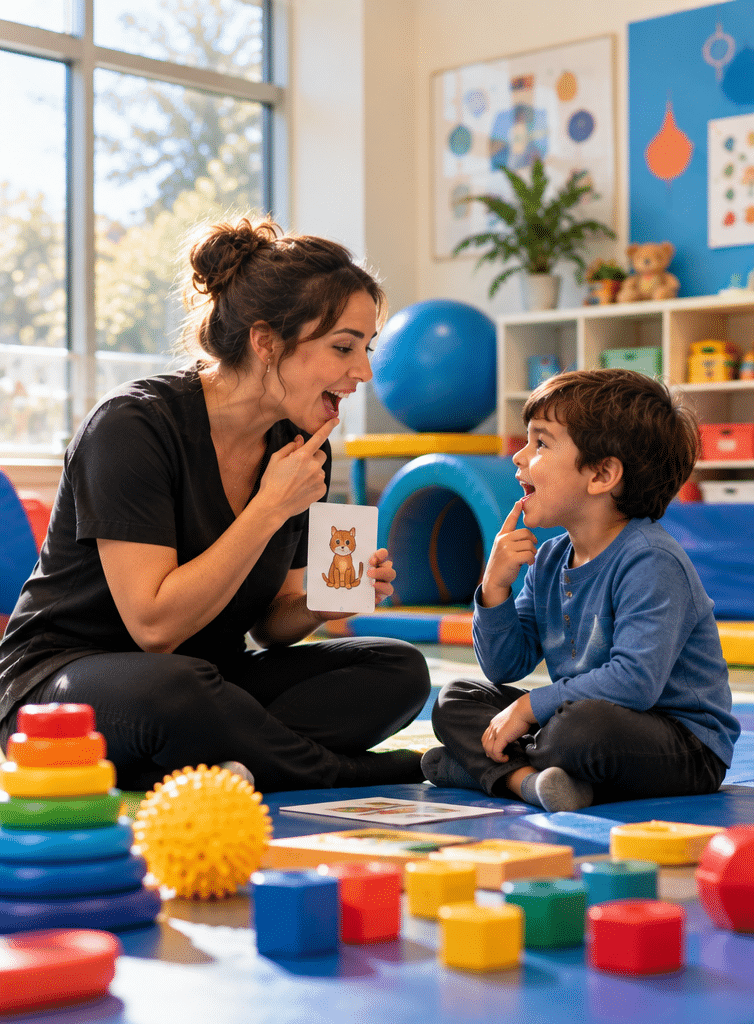
When parents search for speech therapy for kids ontario, they are often looking for answers to an important question: Is my child’s communication developing as expected, and what support is available? Whether your toddler is using fewer words than expected, your preschooler struggles to pronounce certain sounds, or your school-aged child finds conversations challenging, understanding your options is the first step towards getting appropriate support.
Speech and language development is not identical for every child. Some children need help producing speech sounds, while others have difficulty understanding instructions, building sentences, or communicating with friends. Fortunately, Ontario offers several pathways to support, including publicly funded preschool services, school-based programs, and private speech-language therapy.
This guide brings together Ontario government guidance, Canadian paediatric developmental information, and practical strategies used in speech-language therapy. It explains when to seek an assessment, what happens during treatment, how funding works, and how parents can support communication at home.
What Is Speech Therapy for Kids in Ontario?
Speech therapy for kids in Ontario helps children develop clearer speech, understand and use language, communicate with others, and explore alternative communication methods when needed. Registered speech-language pathologists assess communication skills and recommend personalised support, which may include play-based activities, parent coaching, direct therapy, or school-based strategies.

Table of Contents
- Understanding Children’s Speech and Language Development
- Signs Your Child May Need Speech Therapy
- Common Communication Difficulties Speech Therapy Can Address
- How Speech Therapy Assessments Work in Ontario
- Publicly Funded Speech Therapy for Kids in Ontario
- School-Based Speech and Language Support
- Public vs Private Speech Therapy in Ontario
- Costs, Insurance, and Funding Options
- Speech Therapy Methods for Different Ages
- Online vs In-Person Speech Therapy
- Practical Activities Parents Can Try at Home
- Bilingual Children and Inclusive Communication
- Step-by-Step Checklist for Finding a Therapist
- Measuring Your Child’s Progress
- People Also Ask
- Frequently Asked Questions
- Conclusion
1. Understanding Children’s Speech and Language Development
Communication begins long before a child says their first word.
Babies communicate through crying, facial expressions, sounds, eye contact, gestures, and movement. As they grow, these early skills help them understand words, express needs, share experiences, and develop relationships.
However, speech and language are not the same thing.
Speech describes how people physically produce sounds and words. It involves coordinating the lips, tongue, jaw, breathing, and voice.
Language involves understanding and expressing meaning. It includes vocabulary, grammar, sentence structure, and the ability to communicate ideas.
Speech-language pathologists, often called SLPs, work with both.
Understanding Receptive and Expressive Language
Two important aspects of language development are receptive and expressive language.
Receptive language refers to how children understand information.
For example, a child uses receptive language when they:
- Follow a direction such as “Put your shoes beside the door.”
- Identify familiar objects when someone names them.
- Understand questions about a story.
- Recognise words describing actions, locations, or emotions.
Expressive language refers to how children communicate their thoughts, feelings, and needs.
For example, expressive language helps children:
- Ask for food, toys, or assistance.
- Describe something that happened.
- Combine words into meaningful sentences.
- Explain preferences and share opinions.
A child may understand many words but use very few. Another child may speak in long sentences yet struggle to understand complex instructions.
Therefore, a professional assessment considers more than vocabulary or pronunciation alone.
Why Early Communication Support Matters
Strong communication skills help children participate in everyday experiences.
They support learning, friendships, play, emotional expression, and classroom participation.
The Ontario government reports that approximately one in ten children requires additional support with speech or language development.
However, this does not mean every communication difference represents a disorder.
Children develop at different rates, and their experiences, languages, hearing, and developmental profiles can influence how they communicate.
The purpose of speech therapy for kids in Ontario is not to make every child communicate in exactly the same way. Instead, appropriate therapy helps each child develop useful communication skills while respecting their individual strengths.
2. Signs Your Child May Need Speech Therapy in Ontario
Parents sometimes delay seeking advice because they hear that children will eventually grow out of communication difficulties.
While some differences resolve as children develop, others benefit from professional assessment.
Importantly, parents do not need to diagnose a condition before asking for guidance.
Communication Concerns in Babies and Toddlers
Early concerns may involve limited gestures, difficulty responding to sounds, or challenges using words meaningfully.
For example, a parent might notice that their toddler:
- Rarely points to show interest or request something.
- Uses fewer words than expected for their developmental stage.
- Has difficulty understanding familiar instructions.
- Does not often attempt to communicate through gestures, sounds, or words.
- Has stopped using communication skills they previously demonstrated.
However, these observations must be considered within the child’s full developmental history.
According to SickKids’ guidance on speech and language development from birth to age three, communication develops through several stages involving sound production, gestures, understanding, word use, and social interaction.
The resource describes broad developmental expectations, including emerging words around the first birthday, growing vocabulary in toddlerhood, and increasingly complex sentences by age three.
These milestones are useful guides, not diagnostic tests.
If you notice a concern, discussing it with a qualified professional is more helpful than relying on a single milestone.
Speech and Language Concerns in Preschoolers
Between approximately three and five years old, many children begin using longer sentences and more complex language during play.
However, some children experience difficulties such as:
- Being difficult for unfamiliar listeners to understand.
- Struggling to describe events in sequence.
- Having trouble answering questions.
- Using limited sentence structures.
- Experiencing frequent communication frustration.
- Finding it difficult to participate in conversations with peers.
Occasional pronunciation errors can be age-appropriate.
Nevertheless, persistent difficulties that affect everyday communication deserve attention.
Signs in School-Aged Children
School-aged children use language for increasingly complex tasks.
They must follow instructions, explain ideas, understand classroom discussions, and communicate with other students.
Potential concerns include difficulty:
- Retelling stories clearly.
- Understanding detailed verbal instructions.
- Organising thoughts into sentences.
- Producing certain speech sounds consistently.
- Participating in conversations.
- Understanding or using vocabulary needed for learning.
Some children also require support with language skills connected to reading and writing.
Therefore, speech therapy may remain useful beyond the preschool years.
When to Seek Medical Advice
If a child suddenly loses previously acquired communication skills, appears to have significant hearing changes, or develops new swallowing or breathing difficulties, contact an appropriate healthcare professional promptly.
Speech therapy is not a substitute for medical assessment when symptoms suggest an underlying health concern.
3. Common Difficulties Addressed by Speech Therapy for Kids
Speech-language therapy covers several areas of communication.
Understanding these categories can help parents describe their concerns more clearly.
Speech Sound Difficulties
Some children have difficulty producing certain speech sounds or using sound patterns expected for their age.
For example, a child might consistently replace one sound with another or simplify words.
A speech-language pathologist considers the child’s age, speech patterns, language background, and overall intelligibility before deciding whether intervention is needed.
Treatment may include listening activities, sound practice, visual cues, and carefully selected words.
Importantly, exercises are chosen according to the child’s specific needs rather than following the same routine for everyone.
Expressive Language Difficulties
A child with expressive language difficulties may understand much of what others say but struggle to communicate their own ideas.
For example, they may use short phrases, have trouble finding words, or experience difficulty forming sentences.
Therapy can help develop vocabulary, grammar, storytelling, and functional communication.
Parents may also learn to model useful language during everyday routines.
Receptive Language Difficulties
Some children have difficulty understanding spoken language.
They may struggle with longer instructions, unfamiliar vocabulary, or questions that require more complex reasoning.
An SLP may use pictures, gestures, simplified instructions, and repeated opportunities to practise understanding.
These supports can also be shared with caregivers and educators.
Stuttering and Fluency Differences
Stuttering can involve repetitions, prolongations, or blocks during speech.
For example, a child may repeat the beginning of a word or experience difficulty starting a sentence.
Speech-language therapy can help children communicate more comfortably while addressing any frustration, avoidance, or negative feelings associated with speaking.
However, therapy should not suggest that fluent speech is the only acceptable outcome.
Confidence, participation, and respectful communication are equally important.
Childhood Apraxia of Speech
Childhood apraxia of speech is a motor speech disorder that affects the planning and programming of movements needed for speaking.
A child may find it difficult to produce sounds and words consistently, even when they know what they want to say.
This condition requires careful assessment by a qualified professional.
Treatment may involve structured, repeated speech practice with specific feedback.
Social Communication Differences
Social communication involves using language, gestures, and other communication methods during social interactions.
Some children benefit from support with conversation, interpreting language in context, or communicating their preferences and feelings.
For autistic children, appropriate therapy should respect neurodiversity and focus on meaningful communication rather than forcing unnecessary conformity to social expectations.
Augmentative and Alternative Communication
Augmentative and alternative communication, commonly abbreviated as AAC, includes communication methods that supplement or replace spoken language.
Examples include:
- Picture communication boards.
- Gestures and signs.
- Communication books.
- Speech-generating devices.
- Tablet-based communication systems.
AAC can help children express themselves when speech alone is not reliable or sufficient.
Furthermore, AAC does not have to replace speech. It may be used alongside speech as part of a broader communication plan.
4. How Speech Therapy Assessments Work in Ontario
A speech-language assessment helps identify what a child can already do, where communication breaks down, and which supports may be useful.
The process varies with the child’s age, communication profile, and reason for referral.
Step 1: Understanding the Child’s Background
An SLP usually begins by gathering information from parents or caregivers.
Questions may cover:
- Pregnancy, birth, and developmental history.
- Languages spoken at home.
- Hearing concerns or previous hearing tests.
- Medical or developmental diagnoses, where relevant.
- Communication at home, childcare, or school.
- Family priorities and goals.
This information provides essential context.
For example, a child who communicates confidently at home but rarely speaks in an unfamiliar setting may need a different assessment approach from a child who has difficulty communicating across environments.
Step 2: Observing Communication Skills
For younger children, assessment often includes play.
The therapist might use toys, picture books, conversation, and familiar routines to observe how the child communicates.
Older children may complete more structured tasks involving language, speech sounds, storytelling, or conversation.
A qualified clinician chooses assessment methods that fit the child’s needs.
Step 3: Using Standardised or Informal Assessments
Some assessments use standardised tools.
These compare a child’s performance with information gathered from a reference group.
However, standardised scores are not always appropriate for every child, particularly when language background, disability, cultural context, or test conditions affect interpretation.
Therefore, clinicians may combine formal testing with observation, caregiver interviews, language samples, and functional communication tasks.
Step 4: Explaining the Results
After the assessment, the clinician should explain the findings in clear language.
Parents should understand:
- Their child’s communication strengths.
- Which skills need support.
- Whether further evaluation is recommended.
- Available therapy options.
- Suggested goals and home strategies.
A useful assessment does more than identify difficulties.
It helps families decide what to do next.
Step 5: Developing a Personalised Therapy Plan
Therapy goals should reflect the child’s real-life communication needs.
For example, a goal might involve requesting help during play, following classroom directions, or producing a target sound during conversation.
The therapist may recommend direct sessions, parent coaching, consultation, group support, or a combination.
Not every child requires the same frequency or duration of therapy.
5. Publicly Funded Speech Therapy for Kids in Ontario
One of the most useful facts for families is that Ontario provides publicly funded speech and language support for eligible preschool children.
Ontario’s Preschool Speech and Language Program
The provincial Preschool Speech and Language Program supports children from birth until they start school.
The program helps families identify communication concerns and access assessment and appropriate intervention.
Services are publicly funded, and participating families are not charged for program services.
Depending on a child’s needs and the local provider, support may include:
- Speech-language assessment.
- Parent education.
- Individual or group intervention.
- Caregiver coaching.
- Home communication strategies.
- Consultation with people involved in the child’s daily life.
Importantly, the program does not always mean weekly one-to-one therapy.
A therapist may recommend caregiver coaching, group sessions, or other service approaches based on the assessment.
Do Parents Need a Doctor’s Referral?
No. Ontario’s Preschool Speech and Language Program allows families to contact their local provider directly.
A physician’s referral is not required.
This can make accessing early support more straightforward.
Parents can explain their concerns even if their child has not received a formal diagnosis.
Finding Your Local Public Program
Services are organised by geographic area.
For example, families in different parts of Ontario may be served by different regional agencies.
A family in Toronto may follow a different intake pathway from one in Ottawa, Hamilton, Barrie, or North Bay.
Therefore, always confirm which program serves your home address.
Referral deadlines and transition arrangements may also differ between regions, especially around the year a child begins kindergarten.
What About Waiting Lists?
Public services may have waiting periods.
However, no single province-wide waiting time accurately describes every program.
Availability can depend on location, staffing, eligibility, and the type of intervention required.
When contacting a provider, ask:
- Has my child’s referral been received?
- What happens during the intake process?
- Is there an estimated waiting period?
- Are parent workshops available while we wait?
- What happens if my child starts school before receiving services?
Meanwhile, families can use general communication-support strategies at home.
If they choose private therapy, they can also ask whether information from a private assessment may be shared with the public provider, with appropriate consent.
6. School-Based Speech and Language Support in Ontario
When children enter school, the route to speech-language services often changes.
Ontario has school-based rehabilitation services for eligible students attending publicly funded schools.
These services support participation in educational and everyday activities.
However, school-based services may operate differently from preschool programs or private therapy.
How School-Based Support Works
School-based speech-language services may involve:
- Assessment of communication needs.
- Consultation with teachers.
- Strategies for classroom participation.
- Support with speech sound difficulties.
- Recommendations for communication tools.
- Collaboration with parents and school staff.
Depending on the school board and local service arrangements, school-board SLPs and external rehabilitation providers may have different responsibilities.
Therefore, availability and referral processes should be confirmed locally.
How Parents Can Request Support
If your child is having communication difficulties at school, speak with their teacher or principal.
Explain what you have observed and ask how communication concerns are reviewed.
For example, you might say:
“My child understands familiar routines but has difficulty following longer instructions and explaining what happened during the school day. Could we discuss whether a speech-language consultation would be appropriate?”
Specific examples help educators understand the impact on learning and participation.
Supporting the Transition into Kindergarten
The transition from preschool services to school can be stressful for families.
Therefore, planning ahead is helpful.
If your child already receives speech-language therapy, ask the current provider about transition recommendations.
With parental consent, relevant information may be shared with the school or receiving service provider.
Useful documents may include assessment findings, communication goals, effective strategies, and information about assistive communication tools.
Importantly, starting school does not automatically mean that previous therapy arrangements continue unchanged.
Parents should confirm the next steps before the transition.
7. Public vs Private Speech Therapy for Kids in Ontario
Families frequently ask whether publicly funded or private therapy is the better choice.
Both can provide valuable support, but their access pathways and service arrangements differ.
The best option depends on the child’s needs, available programs, and family circumstances.
| Feature | Publicly Funded Services | Private Speech Therapy |
| Cost to families | No direct fee for eligible public program services | Usually paid privately or through eligible insurance benefits |
| Access | Depends on program eligibility and location | Depends on provider availability and service scope |
| Referral | Preschool families can self-refer; school pathways vary | Many practices accept direct parent enquiries |
| Assessment | Based on the relevant program’s service model | Based on the provider’s clinical assessment process |
| Treatment approach | May include parent coaching, groups, consultation, or direct therapy | May include individual sessions, caregiver coaching, groups, or consultation |
| Scheduling | Determined by program capacity and procedures | May offer more scheduling choices, depending on provider |
| School involvement | Often coordinated through public education or rehabilitation systems | Collaboration may be possible with consent and school agreement |
| Waiting periods | Vary by region and service | Vary by practice and clinician |
When Public Speech Therapy May Be Suitable
Public services can be an appropriate starting point for families with eligible preschool children.
They provide access to professional assessment and support without direct program fees.
However, families should understand the available service models rather than expecting a particular number of sessions.
When Private Speech Therapy May Be Suitable
Private therapy may appeal to families seeking a particular appointment schedule, service format, or clinician with experience in a specific communication area.
For example, a family may want evening virtual sessions or individual support that fits around school.
Nevertheless, private therapy is not automatically more effective than publicly funded care.
The quality of assessment, clinical approach, family involvement, and suitability of goals matter more than the payment model alone.
Can Families Use Both?
In some circumstances, families may access public and private support.
However, they should explain existing services to each provider and ask how goals can be coordinated.
This helps prevent conflicting recommendations and unnecessary duplication.
Consent is important whenever professionals exchange information about a child.
8. Speech Therapy Costs and Insurance in Ontario
Cost is an important consideration when families explore private speech therapy for kids in Ontario.
However, there is no universal fee that applies to every provider.
Prices can vary depending on assessment complexity, appointment length, practitioner, location, and service type.
What May Affect Private Therapy Fees?
Several factors can influence the total cost.
Initial assessment: A comprehensive assessment may involve caregiver interviews, testing, scoring, clinical interpretation, and a written report.
Therapy sessions: Session prices may differ according to length and service format.
Reports: Some practices charge separately for detailed reports or additional documentation.
Travel: In-home or community visits may involve travel-related fees.
Consultation: School meetings, caregiver consultations, or professional collaboration may have separate charges.
Therefore, request a clear fee schedule before booking.
Does OHIP Cover Private Speech Therapy?
Parents should not assume private speech-language therapy is covered by the Ontario Health Insurance Plan (OHIP).
OHIP does not generally reimburse routine privately purchased speech-language therapy sessions simply because they are provided by a registered professional.
However, eligible publicly funded programs and certain hospital or rehabilitation services can provide care through separate funding arrangements.
Ask the provider which funding pathway applies to the service you are considering.
Extended Health Insurance Benefits
Some employer-sponsored or private insurance plans include speech-language pathology benefits.
Coverage varies by policy.
Before booking, ask your insurer:
- Are speech-language pathology services included?
- Is there an annual reimbursement limit?
- Is a physician’s referral required under my specific plan?
- Are virtual sessions eligible?
- Must the clinician hold particular registration credentials?
- Are assessments and therapy sessions reimbursed differently?
- What information must appear on the receipt?
These are administrative questions rather than legal or insurance-coverage determinations.
For a binding interpretation of coverage, contact your insurer or plan administrator.
Asking About Total Costs
Rather than comparing only the price of one appointment, ask about the expected service pathway.
For example, you may want to know whether the clinician recommends an assessment before therapy, how goals are reviewed, and whether home activities are included.
A responsible provider should explain the proposed approach without promising a fixed outcome or guaranteeing how many sessions a child will need.
9. Speech Therapy Methods for Children of Different Ages
Speech therapy should match a child’s developmental level, communication needs, and interests.
Consequently, therapy for a two-year-old may look very different from therapy for a nine-year-old.
Speech Therapy for Toddlers
For toddlers, speech-language support often centres on interaction and play.
A therapist may teach caregivers how to build communication opportunities into everyday routines.
For example, during a toy-car game, an adult might model words such as “go”, “stop”, “fast”, and “again”.
The caregiver can then pause and allow the child time to respond.
A response might be a look, gesture, sound, word, or use of a communication device.
The purpose is to encourage meaningful communication without creating unnecessary pressure.
Speech Therapy for Preschoolers
Preschool children often learn through stories, games, and pretend play.
Activities might focus on:
- Following directions.
- Using longer sentences.
- Describing objects.
- Asking and answering questions.
- Improving speech sound production.
- Participating in shared conversations.
For example, a pretend grocery shop can help children practise requesting items, describing colours, and organising ideas.
Additionally, therapists may show caregivers how to continue these activities at home.
Speech Therapy for School-Aged Children
Older children may work on more structured communication goals.
These might involve clear speech, narrative skills, vocabulary, social communication, or language needed for classroom learning.
For example, a child who struggles to retell events might practise organising information into a beginning, middle, and end.
Another child might work on using a target speech sound during spontaneous conversation.
Therapy should also consider the child’s interests and preferences.
This can make activities more relevant and improve participation.
The Role of Parents and Caregivers
Family involvement is a central part of many childhood speech-language interventions.
However, parents are not expected to become professional therapists.
Instead, they can learn a small number of practical strategies that fit into daily life.
For example, using language-building techniques during breakfast may be easier to maintain than introducing lengthy additional exercises.
Consistency should be realistic, positive, and guided by the child’s needs.
10. Online vs In-Person Speech Therapy for Kids in Ontario
Virtual speech-language services have created additional options for Canadian families.
However, online therapy is not suitable for every child, goal, or assessment.
Choosing between online and in-person therapy requires consideration of the child’s needs and the clinician’s judgement.
Advantages of Online Speech Therapy
Virtual sessions can reduce travel and make it easier for caregivers to participate.
They may be useful for families managing work schedules, transportation challenges, or long distances.
For example, an Ontario family living outside a major urban centre may be interested in virtual appointments when suitable providers are available.
Online sessions can also allow therapists to coach caregivers using toys and routines already available in the home.
Limitations of Virtual Therapy
Some children find video sessions difficult to follow.
Others may require hands-on support, specific assessment materials, or environmental adjustments that work better in person.
A young child may also need a caregiver present throughout a virtual session.
Furthermore, unstable internet connections or background distractions can affect participation.
Choosing the Right Format
Ask the prospective therapist:
- Is virtual therapy appropriate for my child’s communication goals?
- What equipment will we need?
- Will a caregiver need to attend?
- How will assessment findings be gathered?
- Can the format change if my child’s needs change?
Ultimately, therapy format should follow clinical needs rather than convenience alone.
11. Practical Speech and Language Activities Parents Can Try at Home
Parents often ask what they can do while waiting for an assessment or between therapy sessions.
Everyday interactions provide useful opportunities to support communication.
However, home activities should complement professional guidance rather than replace assessment when concerns exist.
Activity 1: Expand Your Child’s Words
If your child says “car”, you might respond:
“Big car!”
If they say “dog running”, you could model:
“The dog is running fast.”
This technique provides slightly more complex language without requiring the child to repeat it.
Why it helps: Children hear meaningful vocabulary and sentence patterns connected to something they are already interested in.
Activity 2: Offer Meaningful Choices
During a snack, show two appropriate options.
For example, ask:
“Would you like an apple or a banana?”
Allow the child time to respond in their preferred communication mode.
They may point, say a word, use a gesture, or select an AAC symbol.
Why it helps: Choices create natural opportunities for children to communicate preferences.
Avoid withholding essential food, comfort, or support to force a verbal response.
Activity 3: Read Picture Books Together
Choose a book that interests your child.
Rather than asking a question on every page, describe what is happening.
For example:
“The bear is hiding behind the tree.”
Then pause and allow your child to look, point, comment, or ask something.
Why it helps: Shared reading introduces vocabulary, sentence structures, and opportunities for conversation.
Activity 4: Follow Your Child’s Lead During Play
Allow your child to choose the activity.
If they are interested in toy animals, join that activity rather than redirecting them to a new task.
Use short phrases that relate to their actions.
For example:
“The horse jumps!”
“Now the horse is sleeping.”
Why it helps: Following a child’s interests can make communication more meaningful and engaging.
Activity 5: Build Language into Daily Routines
Daily routines provide repeated opportunities to hear useful words.
During dressing, name clothing items and describe actions.
During cooking, talk about colours, quantities, and steps.
During a walk, notice vehicles, trees, animals, and sounds.
Repetition helps children become familiar with words used in real situations.
Activity 6: Allow Processing Time
Some children need additional time to understand a question or organise a response.
After speaking, pause.
Avoid immediately repeating the question several times or answering for the child.
Why it helps: A comfortable pause gives children more opportunity to respond independently.
Activity 7: Support Every Valid Communication Method
If your child communicates through gestures, pictures, signs, or AAC, respond to those attempts.
For example, when a child points to a ball, you can say:
“You want the ball.”
Then provide the ball when appropriate.
This acknowledges the child’s message and provides a useful language model.
Keep Practice Positive
Speech and language development should not turn every interaction into a test.
Children benefit from opportunities to communicate without feeling constantly corrected.
If an activity becomes frustrating, simplify it, change the activity, or try again later.
For children receiving therapy, prioritise activities recommended by their SLP.
12. Speech Therapy for Bilingual and Neurodivergent Children in Ontario
Ontario families come from many cultural and language backgrounds.
Some children grow up speaking English and French, while others use languages such as Tamil, Punjabi, Mandarin, Arabic, Urdu, or Spanish.
A child’s language background should always be considered during communication assessment.
Does Speaking Two Languages Cause a Speech Delay?
Bilingualism itself is not a speech or language disorder.
Children may distribute their vocabulary and language skills across two or more languages.
For example, a child may know some words in English and other words in a home language.
Therefore, assessing only one language may provide an incomplete picture.
A qualified SLP should ask about the languages used with family members, the child’s exposure to each language, and communication across settings.
Should Parents Stop Speaking Their Home Language?
Families generally do not need to stop using their home language because of communication concerns.
Meaningful conversation in a language caregivers know well can support connection and language learning.
If a child has a communication disorder, the therapist can help the family develop suitable strategies across the child’s languages.
Supporting Autistic and Neurodivergent Children
Some neurodivergent children communicate differently from their peers.
For example, they may use gestures, repeated phrases, AAC, or communication styles that reflect their individual needs.
Therapy should focus on communication access, autonomy, and participation.
Rather than forcing eye contact or eliminating harmless differences, a respectful approach considers what helps the child express needs, make choices, and build relationships.
Individualised Goals Matter
Two children with similar diagnoses may need very different supports.
One child may benefit from a speech-generating device.
Another may need help understanding complex spoken instructions.
A third may communicate well but experience difficulty being understood because of a speech sound disorder.
Therefore, effective therapy begins with individual assessment rather than assumptions based on a diagnosis.
13. Step-by-Step Checklist: Finding Speech Therapy for Kids Ontario
Finding an appropriate therapist can feel complicated, especially when several public and private options are available.
The following checklist provides a practical starting point.
1. Write Down Your Main Concerns
Record specific examples of communication difficulties.
For example:
“My child uses gestures to request things but rarely combines words.”
Or:
“My child speaks clearly at home but struggles to explain ideas during classroom discussions.”
Specific observations make the initial conversation more useful.
2. Consider Your Child’s Age and School Status
Determine whether your child is:
- Not yet attending school.
- Preparing to enter kindergarten.
- Currently attending elementary school.
- Attending secondary school.
This helps identify appropriate public service pathways.
3. Contact the Relevant Public Program
For preschool children, contact the local Preschool Speech and Language Program.
For school-aged children, speak with the school about the applicable communication-support process.
You can also ask local children’s treatment centres about relevant rehabilitation services and eligibility.
4. Research Qualified Private Providers
If you are considering private therapy, verify the clinician’s registration.
In Ontario, professionals practising as speech-language pathologists must be registered with the College of Audiologists and Speech-Language Pathologists of Ontario, known as CASLPO.
Use CASLPO’s public register of speech-language pathologists to confirm registration status and review any listed terms or conditions.
This is an important professional verification step.
5. Ask About Experience With Your Child’s Needs
A therapist who works with preschool language development may have a different clinical focus from one who specialises in complex motor speech disorders.
Ask whether the clinician has appropriate experience with your child’s concerns.
For example, you might ask about childhood apraxia of speech, fluency, AAC, or bilingual language assessment.
6. Clarify the Assessment and Treatment Process
Before booking, ask:
- What happens during the first appointment?
- Will I receive an explanation of the findings?
- How are therapy goals selected?
- How will caregivers be involved?
- How frequently will progress be reviewed?
These questions help clarify expectations.
7. Confirm Fees and Insurance Requirements
For private services, request the current fee schedule.
If you have extended health benefits, verify coverage with your insurer before assuming reimbursement.
Also ask whether any additional reports or consultations have separate fees.
8. Plan for Everyday Practice and Follow-Up
Ask the clinician for a small number of manageable strategies that fit your family’s routine.
Arrange a suitable review point to discuss progress and any changes in your child’s needs.
Most importantly, keep communication open between the therapist, caregivers, and relevant educators.
14. Measuring Progress During Children’s Speech Therapy
Parents naturally want to know whether speech therapy is helping.
However, progress can look different for every child.
For one child, progress may mean using a new gesture to request help.
For another, it may involve using longer sentences or becoming easier to understand.
Set Functional Goals
Good therapy goals connect to everyday situations.
For example:
- Asking for help during play.
- Explaining a problem to a teacher.
- Understanding directions during classroom activities.
- Producing a target speech sound in conversation.
- Using AAC to share opinions or make choices.
Functional goals help families understand why particular skills matter.
Look Beyond Test Scores
Standardised assessments can provide useful information.
However, they do not capture every aspect of communication.
Parents may also notice changes such as:
- Greater participation during family conversations.
- Less frustration when expressing needs.
- More independent communication.
- Increased willingness to share ideas.
- Better understanding of everyday instructions.
These observations can help clinicians evaluate whether strategies are useful outside sessions.
Ask for Regular Reviews
Progress reviews should examine the child’s goals and response to intervention.
If an approach is not helping, the clinician may adjust the activities, service format, or goals.
Some children make changes quickly in a specific skill, while others require sustained support.
There is no responsible way to guarantee a particular outcome or timeline for every child.
15. People Also Ask: Speech Therapy for Kids Ontario
At what age should a child start speech therapy in Ontario?
Children can receive speech-language support from infancy when communication concerns are identified. The appropriate time to seek an assessment depends on the child’s development and needs, so parents do not have to wait until school age.
Is speech therapy free for children in Ontario?
Eligible preschool children can access Ontario’s publicly funded Preschool Speech and Language Program without direct program fees. School-based and other publicly funded services may also be available, while private therapy generally involves separate fees.
Can parents refer their child for speech therapy without a doctor?
Yes. Parents can contact Ontario’s Preschool Speech and Language Program directly without a physician’s referral. However, other services may have different intake requirements, so confirm the process with the relevant provider.
How long does speech therapy take for children?
The length of therapy depends on the child’s communication needs, goals, and response to intervention. A speech-language pathologist can explain the recommended approach and review progress over time, but a fixed number of sessions cannot guarantee an outcome.
16. Frequently Asked Questions About Speech Therapy for Kids in Ontario
1. What happens if my child begins kindergarten while waiting for speech therapy?
Preschool and school-based services have different eligibility and transition arrangements.
Therefore, contact your current preschool program before school starts and ask what happens to your child’s referral or treatment plan.
If your child continues to need support, ask how information can be transferred to the appropriate school or community service with your consent.
You should also inform the school about communication concerns early, rather than assuming the existing referral will transfer automatically.
2. Should my child have a hearing assessment before speech therapy?
Hearing plays an important role in speech and language development.
If there are concerns about how your child responds to sounds or speech, an SLP or healthcare professional may recommend an audiological assessment.
An audiologist is the professional who evaluates hearing.
A speech-language assessment and a hearing assessment examine different areas, and both may be relevant.
For example, a child who frequently misunderstands spoken instructions may need their hearing considered as part of a comprehensive evaluation.
The appropriate next step depends on the child’s history and symptoms.
3. What if my child will not speak during the speech therapy assessment?
Some children communicate differently in unfamiliar settings.
For example, a child may be talkative at home but quiet during the first appointment.
A qualified clinician can consider caregiver reports, observations, play, and other assessment methods rather than relying only on speech produced during one visit.
Parents may be asked to describe communication at home or provide relevant examples.
However, the therapist should decide what information is clinically useful and how to gather it appropriately.
A child should not be pressured to perform simply to complete an assessment.
4. Can a private speech therapist coordinate with my child’s teacher?
Yes, collaboration may be possible when everyone involved agrees and appropriate consent is obtained.
A private SLP might share communication strategies, assessment recommendations, or relevant goals with school staff.
For example, a therapist could recommend visual supports or ways to simplify complex instructions.
However, schools have their own processes and responsibilities.
Therefore, ask both the therapist and school how information-sharing and collaboration can be arranged.
5. How do I know whether my child’s speech therapy goals need to change?
Therapy goals should be reviewed as the child develops and their communication needs change.
For example, a child who initially needed help requesting basic items may later benefit from support with storytelling or classroom participation.
Parents can discuss new concerns, achievements, and everyday communication challenges during progress reviews.
A clinician may recommend adjusting goals, changing the therapy approach, or reducing or ending services when appropriate.
Progress is not always linear, so decisions should consider the child’s broader functioning rather than one successful or difficult session.
17. Conclusion: Helping Your Child Communicate With Confidence
Finding speech therapy for kids in Ontario does not have to begin with a diagnosis or a complicated treatment plan.
It begins with recognising your child’s strengths, noticing where communication is difficult, and seeking appropriate guidance.
Ontario families can explore publicly funded preschool programs, school-based services, children’s rehabilitation programs, and private therapy.
Furthermore, communication support can take many forms, from speech sound practice and language-building activities to caregiver coaching and AAC.
The most suitable approach depends on your child’s individual needs.
If you are exploring private services, Speech For All offers support for children with speech sound difficulties, language challenges, stuttering, apraxia, AAC needs, and other communication concerns. Its published approach includes individualised assessment, functional therapy, family collaboration, and virtual service options.
Parents can also begin by discussing their concerns through the practice’s advertised free 30-minute consultation.
Take the next step: Explore Speech For All’s personalised speech therapy services and free consultation options to learn more about appropriate support for your child’s communication needs.
Every child’s communication journey is different. With informed guidance, realistic goals, and supportive everyday interactions, families can help children develop skills that matter at home, at school, and in their communities.
Medical information disclaimer: This article provides general educational information and does not replace an individual assessment, diagnosis, or treatment recommendation from a qualified healthcare professional. Program eligibility, service availability, and insurance terms should be confirmed directly with the relevant organisation.
Tags: how much does speech therapy cost in ontario, is speech therapy covered by ohip, speech therapist for kids near me, speech therapy activities for 10 year olds, speech therapy for kids london ontario, speech therapy for kids ontario