

Choosing a speech pathologist office is an important decision when you or your child needs help with speech, language, communication, voice, fluency, or swallowing. For Canadian families, however, finding the right clinic involves more than choosing a convenient location. You also need to understand professional qualifications, provincial regulation, assessment processes, public and private services, fees, and what to expect during an appointment.
A speech-language pathologist (S-LP) is a health professional who assesses and treats a broad range of communication and swallowing disorders. Speech-Language & Audiology Canada (SAC) notes that S-LPs work with people across the lifespan and may support speech, language, fluency, voice, feeding, swallowing, social communication, and literacy-related needs.
This guide explains what to look for in a speech pathologist office in Canada, how appointments typically work, and how to make a more informed choice without relying on exaggerated promises or one-size-fits-all advice.
What Is a Speech Pathologist Office?
A speech pathologist office is a clinic or professional practice where a speech-language pathologist assesses and treats communication-related concerns. Services may include speech, language, fluency, voice, social communication, and swallowing support. Depending on the clinic, appointments may take place in person, virtually, at home, or in another appropriate setting.
Table of Contents
- What Does a Speech Pathologist Office Do?
- Who Can Benefit From a Speech Pathologist Office?
- Services You May Find at a Speech Pathologist Office
- Speech Pathologist Office vs. Other Health Services
- What Happens at a Speech Pathologist Office Appointment?
- How Speech-Language Assessments Work
- Choosing a Speech Pathologist Office in Canada
- Public vs. Private Speech-Language Services
- Understanding Speech Pathologist Office Costs
- Insurance and Administrative Questions
- In-Person vs. Virtual Speech Pathologist Office Services
- How to Prepare for Your Appointment
- A Speech Pathologist Office Checklist
- Questions to Ask Before Choosing a Clinic
- People Also Ask
- Q&A: Expert Questions About a Speech Pathologist Office
- Conclusion
What Does a Speech Pathologist Office Do?
A speech pathologist office provides professional assessment and treatment for communication and, where appropriate, swallowing concerns.
Although many people associate speech-language pathology with children who have difficulty saying certain sounds, the profession is much broader.
According to Speech-Language & Audiology Canada, S-LPs can help with:
- Speech delays and speech sound disorders.
- Language delays and disorders.
- Understanding and expressing language.
- Stuttering and other fluency concerns.
- Voice and resonance concerns.
- Social communication.
- Feeding and swallowing difficulties.
- Cognitive-communication difficulties.
- Literacy-related communication skills.
- Communication difficulties associated with other medical or developmental conditions.
Therefore, the right clinic depends on the reason you are seeking support.
For example, a parent searching for a clinic for a three-year-old with limited vocabulary may need a provider with strong early-childhood experience. Meanwhile, an adult experiencing voice problems may need a clinician with specific voice expertise.
A good speech pathologist office should make its areas of practice clear before you book.
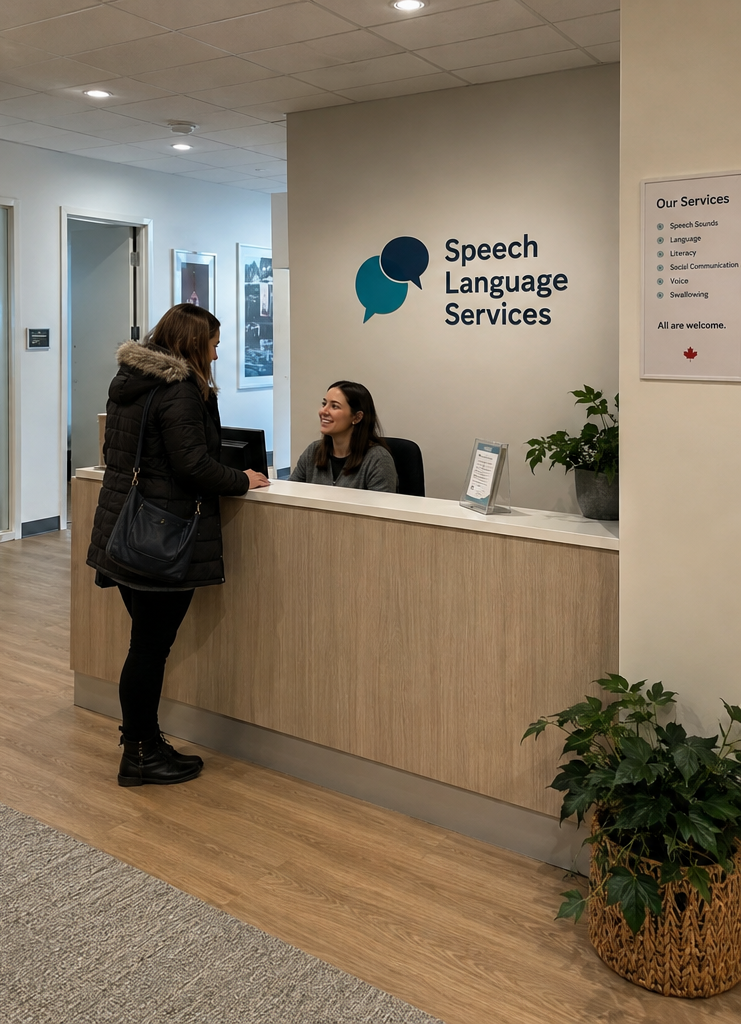
Why the office environment matters
The physical or virtual environment can affect how comfortable a client feels.
For children, a welcoming space with age-appropriate materials can make it easier to observe communication during play. For adults, a quiet room can make conversation, speech assessment, and voice work more practical.
However, the appearance of a clinic is not the most important factor.
Professional qualifications, clinical experience, assessment methods, communication with families, and appropriate treatment planning matter more than décor.
Who Can Benefit From a Speech Pathologist Office?
People of all ages may benefit from speech-language pathology services.
Children
A child may be referred or brought to a speech pathologist office because of:
- Limited vocabulary.
- Difficulty understanding language.
- Difficulty combining words.
- Speech sound difficulties.
- Reduced speech intelligibility.
- Stuttering.
- Social communication concerns.
- Communication difficulties associated with developmental conditions.
- Feeding or swallowing concerns.
For children, parents and caregivers are often an important part of the process.
The clinician may provide strategies that can be used during meals, play, reading, dressing, outings, and other everyday routines.
Adults
Adults may seek an S-LP for:
- Stuttering.
- Voice changes.
- Speech difficulties after neurological injury.
- Language difficulties following stroke.
- Cognitive-communication difficulties.
- Accent-related communication goals when appropriate.
- Swallowing difficulties.
- Speech difficulties associated with neurological conditions.
The exact services depend on the clinician’s competence and the needs of the client.
Older adults
Speech-language pathology can also support older adults experiencing communication or swallowing changes.
For instance, an S-LP may work with someone who has difficulty communicating after a stroke or who has swallowing difficulties associated with a neurological or medical condition.
SAC describes speech-language pathologists as health professionals who identify, assess, and treat communication and swallowing disorders across the lifespan.
Services You May Find at a Speech Pathologist Office
Not every clinic offers every service.
Before booking, check whether the office works with your age group and specific concern.
Speech assessment
A speech assessment examines how a person produces speech sounds and communicates verbally.
For children, the clinician may look at sound patterns, intelligibility, and the ways speech production affects everyday communication.
Language assessment
Language assessment may examine both understanding and expression.
This can include vocabulary, sentence structure, following directions, answering questions, conversation, and other communication skills.
Fluency assessment
For people who stutter, an assessment can examine speech fluency and how disruptions affect communication and participation.
The clinician may consider not only the observable speech behaviours but also the person’s communication experience.
Voice assessment
Voice services can address concerns involving pitch, loudness, quality, vocal endurance, or other aspects of voice.
A voice concern may sometimes require collaboration with a physician or other health professional.
Feeding and swallowing
Some speech-language pathologists work with feeding and swallowing concerns.
This area requires specific knowledge and competence. If swallowing safety is a concern, ask the clinic whether the clinician has the relevant experience before booking.
Social communication
Some clients need support using communication effectively in social situations.
For children, this might involve conversational interaction, turn-taking, interpreting communication, or adapting language to different situations.
Parent and caregiver coaching
For young children, caregiver involvement can be especially useful.
Rather than relying only on what happens during a clinic appointment, the clinician may show caregivers how to support communication during everyday activities.
Speech Pathologist Office vs. Other Health Services
A speech-language pathologist does not work in isolation in every case.
Depending on the person’s needs, an S-LP may collaborate with physicians, audiologists, occupational therapists, physiotherapists, psychologists, educators, dietitians, social workers, or other professionals. SAC’s Canadian scope-of-practice document specifically describes S-LPs as working independently or within interprofessional teams.
Here is a simple comparison:
| Service or professional | Main area of focus | When it may be relevant |
| Speech-language pathologist | Speech, language, communication, fluency, voice and some swallowing concerns | Communication or swallowing difficulties |
| Audiologist | Hearing and auditory-related concerns | Hearing concerns or when hearing may affect communication |
| Family doctor | General medical care | Initial medical concerns, referrals or broader health issues |
| Occupational therapist | Daily activities, participation, sensory and functional skills | Functional or developmental concerns beyond communication |
| Physiotherapist | Movement and physical function | Motor or mobility concerns |
| Psychologist | Mental health, behaviour and psychological assessment | Psychological or behavioural concerns within their scope |
| Educator | Learning and classroom participation | School-based learning and communication support |
The goal is not to decide which professional is “best.”
Instead, the goal is to identify which type of assessment matches the concern.
What Happens at a Speech Pathologist Office Appointment?
Many people feel uncertain before their first appointment.
Knowing what to expect can make the experience easier.
Step 1: Intake
The clinic may ask for basic information about the client and the reason for seeking services.
For a child, intake questions might cover:
- Developmental history.
- Communication milestones.
- Languages spoken at home.
- Hearing history.
- Medical information.
- Childcare or school information.
- Previous assessments.
- Current concerns.
For an adult, questions may focus on medical history, communication changes, medications where relevant, previous diagnoses, and daily communication needs.
Step 2: Discussion of concerns
The clinician usually wants to understand what is happening in everyday life.
For example, a parent may say:
“My child can say several words, but strangers cannot understand them.”
That information is more useful than simply saying the child has a “speech delay.”
Specific examples help the clinician understand the functional impact of the concern.
Step 3: Assessment
Assessment methods vary by age and concern.
A young child may be observed during play. An adult may complete structured tasks or conversation-based activities.
Standardized tests may be used when appropriate.
The clinician may also gather information from caregivers, teachers, or other professionals when relevant and with appropriate authorization.
Step 4: Explanation of findings
A quality appointment should leave you with a clearer understanding of the results.
Ask the clinician to explain unfamiliar terminology.
You should be able to understand:
- What the clinician observed.
- What the client does well.
- What areas require attention.
- Whether further assessment is recommended.
- Whether therapy is recommended.
- What the goals may be.
- How progress will be monitored.
Step 5: Recommendations
Recommendations can vary significantly.
Some people may be advised to begin therapy. Others may receive strategies to practise at home and return for monitoring.
A recommendation should be connected to the assessment findings rather than based solely on a generic treatment package.
How Speech-Language Assessments Work
A speech-language assessment is not simply a test of how many words someone can say.
Instead, the clinician builds a broader communication profile.
For a toddler, that profile could include:
- Understanding spoken language.
- Expressing wants and ideas.
- Vocabulary.
- Combining words.
- Gestures.
- Social interaction.
- Speech sounds.
- Play.
- Attention and interaction.
- Communication with familiar and unfamiliar people.
For an adult, assessment may consider speech clarity, language comprehension, verbal expression, reading, writing, cognition, voice, fluency, or swallowing, depending on the reason for referral.
Why assessment matters
Treatment should address an identified need.
For example, two children may both speak very little but have different underlying profiles.
One child might understand language well but have difficulty producing spoken words. Another might have difficulty both understanding and expressing language.
Their support plans may therefore be different.
This is why choosing a speech pathologist office based solely on a generic service description may not be enough.
Ask whether the clinician has experience with your particular concern.
Choosing a Speech Pathologist Office in Canada
Canada has a mixture of public and private health services, and access varies by province and territory.
Speech-language pathology is regulated in many Canadian jurisdictions. SAC provides a directory of regulatory and licensing bodies across Canada and explains that registration requirements can differ between jurisdictions.
Ontario, for example, lists audiology and speech-language pathology among its regulated health professions. Ontario’s regulatory framework establishes profession-specific rules and protected titles. (Ontario)
Therefore, when choosing a speech pathologist office, verify the clinician’s current registration where applicable.
SAC also offers a public directory that can help people locate speech-language pathologists and audiologists by Canadian province or territory. (SAC-OAC)
What to look for
Consider these factors:
1. Professional credentials
Check the clinician’s qualifications and applicable provincial or territorial registration.
2. Relevant experience
A clinician who primarily works with preschool children may not be the best fit for an adult voice concern.
3. Assessment approach
Ask how the clinic evaluates clients and whether assessment includes more than one source of information.
4. Communication with families
The clinician should explain recommendations clearly.
5. Treatment goals
Goals should relate to meaningful communication needs rather than simply increasing the number of appointments.
6. Location
Consider travel time, parking, public transit, accessibility, and appointment scheduling.
7. Virtual options
If appropriate, ask whether virtual appointments are available.
8. Language and cultural considerations
If your family uses French, English, or another language at home, ask whether the clinician can support your communication needs or arrange appropriate resources.
Public vs. Private Speech-Language Services
One of the biggest questions for Canadian families is whether speech-language services are publicly funded.
The answer is not the same everywhere.
Canada’s healthcare system is administered through provincial and territorial systems, and provinces and territories determine which services are publicly covered in their respective programs. The federal government explains that Canada’s public health insurance plans cover medically necessary insured services, while coverage outside those services can vary. (Canada)
Speech-language services may be available through different routes, including:
- Publicly funded programs.
- Hospitals.
- Community health programs.
- Schools.
- Early childhood programs.
- Rehabilitation programs.
- Private clinics.
Eligibility and wait times can differ.
Therefore, do not assume that a service available publicly in one province is available under the same conditions elsewhere.
Public services
Potential advantages can include lower direct costs for eligible clients.
However, eligibility requirements, service models, referral processes, and waiting periods vary.
Private services
Private clinics may offer more flexible scheduling or specialized services.
However, fees are generally paid by the client unless covered by an employer benefits plan, insurance policy, another funding source, or a specific program.
A private clinic can also be useful when a family needs a particular specialization that is not readily available through a public pathway.
Neither option is automatically better.
The appropriate choice depends on the client’s needs, eligibility, location, finances, availability, and goals.
Understanding Speech Pathologist Office Costs
There is no single Canada-wide fee for speech-language pathology.
Private fees can vary based on:
- Assessment type.
- Appointment length.
- Clinician experience.
- Location.
- Specialization.
- Whether the service is individual or group-based.
- Whether the appointment is in person or virtual.
- Whether a written report is included.
Because fees change and clinics use different pricing structures, parents and clients should request the current fee schedule directly from the office.
Ask whether the quoted fee includes:
- Initial consultation.
- Assessment.
- Written report.
- Follow-up appointment.
- Therapy sessions.
- Parent coaching.
- Communication with other professionals.
- Administrative letters or forms.
Do not assume that an assessment fee automatically includes ongoing therapy.
What about insurance?
Private speech-language services may be eligible under some extended health benefits plans, but coverage varies.
For example, the federal Public Service Health Care Plan currently lists speech-language pathologist and audiologist services under eligible benefits, subject to the plan’s stated limits and conditions. (Canada)
That example should not be interpreted as a statement about every Canadian insurance plan.
Before booking a large block of appointments, contact your insurer and ask about:
- Whether S-LP services are covered.
- Annual or lifetime limits.
- Whether a physician referral is required.
- Whether the provider must meet specific registration requirements.
- Whether a prescription or treatment plan is required.
- Whether direct billing is available.
These are administrative questions, not legal advice. Coverage decisions should be confirmed with your insurer and, where necessary, reviewed with the appropriate licensed professional or plan administrator.
Insurance and Administrative Questions
A professional speech pathologist office should be able to explain its administrative procedures clearly.
You may want to ask:
- Do you provide receipts?
- Do you offer direct billing?
- What information appears on receipts?
- What is your cancellation policy?
- How are missed appointments handled?
- Is a written assessment report included?
- How are records requested or transferred?
- What happens if another professional needs information?
- How are virtual appointments handled?
Keep copies of receipts, assessment reports, and other relevant documents.
If your insurer requires specific information, ask the clinic before the appointment rather than after treatment begins.
In-Person vs. Virtual Speech Pathologist Office Services
A speech pathologist office does not always have to be a physical clinic.
Telepractice can allow an S-LP to provide services remotely when clinically appropriate and when the necessary technology and privacy arrangements are in place.
SAC includes telepractice resources within its professional practice materials, reflecting the role of remote service delivery within speech-language pathology. (SAC-OAC)
In-person appointments
An in-person appointment may be preferable when:
- Physical observation is important.
- A child engages better in a clinic environment.
- Feeding or swallowing assessment requires specific equipment or observation.
- The clinician determines that face-to-face assessment is clinically appropriate.
- The family prefers in-person interaction.
Virtual appointments
Virtual services may be useful when:
- Travel is difficult.
- The client lives far from a specialized provider.
- Parent coaching is a major part of the service.
- The clinician determines that the concern can be assessed or treated effectively online.
However, virtual care is not automatically appropriate for every client or every concern.
Ask the clinician whether telepractice is suitable for your specific situation.
How to Prepare for Your Appointment
A little preparation can make an assessment more useful.
You do not need to train yourself to become a speech therapist before attending.
Instead, gather practical information.
For a child, consider writing down:
- Words and phrases your child currently uses.
- Languages your child hears and speaks.
- Examples of communication difficulties.
- Situations in which communication is easiest.
- Situations in which communication is difficult.
- Relevant hearing information.
- Previous assessments.
- Daycare or preschool observations.
- Questions you want answered.
For an adult, consider noting:
- When the communication problem began.
- Whether it appeared suddenly or gradually.
- Situations where communication is difficult.
- Situations where communication is easier.
- Relevant medical history.
- Previous therapy.
- Current communication goals.
If you have videos that demonstrate a concern, ask the clinician whether they would be useful.
For example, a short recording of a child’s natural communication at home may provide context that is difficult to reproduce during a clinic visit.
A Speech Pathologist Office Checklist
Use this numbered checklist when comparing clinics.
- Confirm the service matches your concern.
Check whether the clinician works with your age group and communication issue. - Verify professional registration where applicable.
Check the relevant provincial or territorial regulatory body. - Ask about assessment methods.
Find out what the first appointment includes. - Ask about fees before booking.
Request current assessment and therapy fees. - Check insurance requirements.
Confirm coverage directly with your benefits provider. - Ask about reports.
Find out whether a written report is included and what it covers. - Discuss appointment frequency.
Ask what schedule may be recommended if therapy is needed. - Ask about caregiver involvement.
For children, understand how parents or caregivers will participate. - Discuss language needs.
Tell the clinic about the languages used by the client and family. - Ask how progress is measured.
A clear plan should include ways to review whether goals are being met. - Review cancellation policies.
Understand administrative requirements before booking recurring sessions. - Choose a practical service model.
Consider clinic, home, school, community, or virtual options when available and appropriate.
Questions to Ask Before Choosing a Clinic
A short phone call can help you decide whether a speech pathologist office is suitable.
“Do you work with my age group?”
A clinician who specializes in toddlers may have a different practice focus from one who primarily sees adults.
“Do you assess this specific concern?”
Be specific.
Instead of saying “speech problem,” say “my child has difficulty combining words” or “I have noticed a recent change in my voice.”
“What happens during the first appointment?”
The answer should give you a reasonable understanding of the assessment process.
“Will parents be involved?”
For young children, caregiver involvement may be an important part of intervention.
“How do you set goals?”
Look for goals that connect to real-world communication.
“How do you measure progress?”
The clinic should be able to explain how progress will be reviewed.
“What happens if you think another professional should be involved?”
Good care sometimes involves collaboration.
People Also Ask
What should I look for in a speech pathologist office in Canada?
Look for an appropriately qualified and, where applicable, provincially or territorially registered S-LP with experience relevant to your concern. Also consider assessment methods, communication style, fees, location, accessibility, and how the clinician involves clients or caregivers.
Do I need a doctor’s referral to visit a speech pathologist office?
It depends on the service pathway and jurisdiction. Some private clinics accept self-referrals, while particular public programs or insurance plans may have their own requirements, so confirm the process with the clinic and your insurer.
How much does a speech pathologist office charge in Canada?
Private fees vary across Canada and between clinics. Ask for the current fee schedule and clarify what is included in assessment, reporting, therapy, and follow-up services.
Are speech pathologist services covered by Canadian health insurance?
Coverage depends on the province, program, employer benefits plan, insurer, and individual eligibility. Public health insurance does not mean that every speech-language service is automatically covered, so confirm your specific coverage before treatment.
Can a speech pathologist office provide virtual appointments?
Some clinics offer telepractice when appropriate. Whether virtual care is suitable depends on the client’s needs, the clinician’s assessment, technology, and applicable professional requirements.
Q&A: Expert Questions About a Speech Pathologist Office
1. What is the difference between a speech pathologist office and a speech therapy clinic?
In everyday use, these terms may refer to similar services.
“Speech-language pathologist” identifies the professional, while “speech therapy clinic” describes a setting where therapy may be provided.
When choosing a clinic, focus less on the wording used in its name and more on the qualifications, registration, experience, and services offered by the clinician.
2. Should I choose a general speech pathologist office or a specialist clinic?
Choose based on the complexity and type of your concern.
A general clinic may be appropriate for common speech or language concerns. However, if the client has a specialized need involving voice, swallowing, complex communication, neurological conditions, or another specific area, it may be useful to find an S-LP with relevant clinical experience.
Ask the clinic directly about the clinician’s caseload and experience.
3. How long does a speech-language assessment take?
There is no universal appointment length.
The time required depends on the person’s age, communication concerns, assessment methods, attention, medical history, language background, and whether a written report is required.
A complex assessment may involve more than one appointment.
Rather than choosing a clinic because it advertises the shortest assessment, ask whether the assessment process is appropriate for the concern being evaluated.
4. What makes a speech pathologist office family-friendly?
For children, a family-friendly clinic should make it easy for parents to understand the assessment and participate in care.
Useful features may include child-appropriate assessment activities, clear communication with caregivers, practical home strategies, flexible scheduling, and respect for the family’s language and cultural background.
However, “family-friendly” should not replace clinical quality. Professional competence remains the priority.
5. How can I tell whether a speech pathologist office is using an evidence-informed approach?
Ask the clinician to explain why a particular assessment or treatment approach is being recommended.
A strong answer should connect the approach to the client’s individual needs and current professional knowledge. The clinician should also be willing to discuss uncertainty, limitations, alternatives, and how progress will be evaluated.
SAC’s national competency profile emphasizes professional standards, regulatory requirements, ethical practice, confidentiality, and working within professional and individual competence. (SAC-OAC)
What Good Communication Looks Like in a Speech Pathologist Office
The quality of a clinic experience is not only about the treatment room.
Communication between the clinician and client or family matters too.
A strong speech pathologist office should make it possible to ask questions without feeling rushed.
You should be able to say:
“I do not understand that term.”
“Can you explain why this assessment is needed?”
“What does this result mean for everyday life?”
“What should we do between appointments?”
“How will we know whether the plan is helping?”
These are reasonable questions.
For children, parents should also feel that their observations are valued. Caregivers often see communication across many settings, while a clinician may see the child for a limited period.
Combining those perspectives can provide a more complete picture.
What to Expect From Professional Standards in Canada
Speech-language pathology is a regulated profession in many Canadian jurisdictions, but the exact regulatory framework varies.
SAC explains that S-LPs working in regulated provinces and territories must meet the requirements of the applicable regulatory body. Its scope-of-practice guidance also states that current entry to practice requires a master’s degree in speech-language pathology or equivalent. (SAC-OAC)
SAC’s voluntary certification program is separate from provincial or territorial regulation. SAC explains that regulatory bodies oversee licensing and title protection, while SAC certification is a voluntary professional distinction. (SAC-OAC)
That distinction is useful for consumers.
When checking a clinician, start with the applicable regulator for the province or territory where the professional practises. Then consider additional professional credentials, experience, specialization, and clinic quality.
What a Good Treatment Plan Should Include
A treatment plan should be understandable.
Depending on the client, it may identify:
- The main communication concern.
- Relevant strengths.
- Specific functional goals.
- Recommended strategies.
- Who will participate.
- Expected appointment frequency.
- Ways progress will be monitored.
- When the plan will be reviewed.
For example, a child’s goal might relate to communicating requests more effectively during everyday routines.
An adult’s goal might relate to being better understood during workplace conversations.
Functional goals connect therapy to real life.
That connection is important because communication is not simply a collection of test scores.
When a Different Professional May Be Needed
Sometimes an S-LP is not the only professional who should be involved.
For example, a hearing concern may warrant audiology assessment.
A swallowing concern may require medical evaluation and specialized S-LP involvement.
A broader developmental concern may benefit from assessment by several professionals.
The appropriate pathway depends on the individual.
A speech pathologist office should not attempt to manage concerns outside the clinician’s competence. Instead, the clinician may recommend referral or collaboration when appropriate.
That is a positive sign, not a weakness.
Good healthcare often involves knowing when another professional’s expertise is needed.
How to Compare Canadian Speech Pathologist Offices
When you have several options, create a simple comparison.
| Factor | Office A | Office B | Office C |
| Relevant age-group experience | |||
| Relevant clinical specialization | |||
| Registration verified | |||
| Assessment process explained | |||
| Fees clearly provided | |||
| Insurance receipts available | |||
| In-person appointments | |||
| Virtual appointments | |||
| Caregiver involvement | |||
| Progress monitoring explained | |||
| Location and accessibility | |||
| Communication style |
Do not choose solely on price or online reviews.
Reviews can provide information about scheduling and customer experience, but they cannot establish whether a clinical approach is appropriate for your particular needs.
Similarly, an attractive website does not prove clinical quality.
Use several sources of information.
Finding Reliable Canadian Information
Online information about speech and language can vary greatly in quality.
When researching a speech pathologist office, prioritize sources from:
- Canadian professional organizations.
- Provincial or territorial regulators.
- Government health agencies.
- Established hospitals or healthcare institutions.
- Qualified health professionals.
Speech-Language & Audiology Canada provides public information about S-LPs and a directory for finding professionals across Canadian provinces and territories. (SAC-OAC)
The Government of Canada also explains how healthcare responsibilities are divided between federal, provincial, and territorial systems. This is important because the availability and funding of services can vary by jurisdiction. (Canada)
When you find advice online, check whether it applies to Canada and whether it is current.
Final Advice Before Booking a Speech Pathologist Office
If you are searching Google for a speech pathologist office, start with your actual need.
Ask yourself:
Who needs help?
A toddler, school-aged child, teenager, adult, or older adult may need different expertise.
What is the concern?
Speech sounds, language, stuttering, voice, social communication, literacy, feeding, or swallowing can require different clinical skills.
Where are you located?
Public programs, regulators, referral pathways, and funding can vary across Canada’s provinces and territories.
What type of service do you need?
Assessment, therapy, consultation, parent coaching, or a combination may be appropriate.
What questions do you want answered?
Write them down before the appointment.
That preparation can help you get more value from the first conversation.
Conclusion
Finding the right speech pathologist office in Canada starts with understanding what speech-language pathologists actually do. They support a broad range of communication needs across the lifespan, including speech, language, fluency, voice, social communication, literacy-related skills, and swallowing concerns.
Because Canadian healthcare and professional regulation vary by province and territory, families should verify the clinician’s applicable registration, ask about relevant experience, understand assessment and treatment processes, and confirm fees or insurance coverage before beginning services.
Most importantly, look for a clinic that explains its recommendations clearly and connects therapy goals to real-life communication.
If you are researching speech-language services and want to explore professional support, visit Speech For All’s Canadian speech-language resources for more information and practical next steps.
A well-chosen speech pathologist office should do more than provide appointments. It should help you understand the communication concern, identify realistic goals, and make informed decisions about the next stage of care.
Tags: speech language pathologist office, speech pathologist department of education, speech pathologist department of education salary, speech pathologist office, speech pathologist office jobs, speech pathologist offices near me, speech pathology office assistant, speech pathology office decor, speech pathology office jobs near me, speech pathology offices hiring