

If you are searching for a pediatric speech pathologist near me, you are probably looking for more than an address. You may want to know whether your child’s speech or language development is on track, what an assessment involves, how to find a qualified professional in Canada, and whether your child actually needs therapy.
Those are reasonable questions.
Speech and language development varies from child to child. At the same time, persistent difficulties with understanding language, expressing ideas, producing speech sounds, fluency, social communication or feeding and swallowing can affect participation at home, school and in the community.
A speech-language pathologist (S-LP) is a professional who assesses and treats communication and swallowing difficulties. In Canada, the profession is regulated in several provinces and territories, so checking professional credentials is an important part of choosing a provider. The Government of Canada’s Job Bank notes that S-LPs require a master’s degree in speech-language pathology and that registration with a regulatory body is required in a number of Canadian jurisdictions. (Job Bank)
This guide explains how Canadian families can approach the search, what to expect, and how to decide whether a particular clinician is a good fit.
What is a pediatric speech pathologist near me?
A pediatric speech pathologist near me is a speech-language pathologist who works with children experiencing speech, language, communication, fluency, voice, feeding or swallowing difficulties. Families can look for qualified professionals through provincial services, private clinics, schools, healthcare providers and professional directories across Canada.
Table of Contents
- What does a pediatric speech pathologist do?
- When should I look for a pediatric speech pathologist near me?
- What can a pediatric speech pathologist help with?
- Speech versus language: Why the difference matters
- How to find a pediatric speech pathologist near me in Canada
- What qualifications should a Canadian S-LP have?
- Public versus private pediatric speech-language services
- What happens during a pediatric speech assessment?
- What happens after an assessment?
- How parents can support speech and language development
- Finding the right pediatric speech pathologist near me
- Questions to ask before booking
- Costs and funding in Canada
- Telepractice and virtual speech therapy
- Bilingual and multilingual children
- Speech-language therapy and school support
- People Also Ask
- Pediatric speech pathologist checklist
- Q&A
- Conclusion
What Does a Pediatric Speech Pathologist Do?
A pediatric speech-language pathologist works with children and families to assess, understand and support communication or swallowing concerns.
The term speech-language pathologist can sound very specific, but the profession covers much more than pronunciation.
Depending on their training and clinical role, an S-LP may work with:
- Speech sound difficulties
- Language development
- Understanding spoken language
- Expressing thoughts and ideas
- Stuttering
- Social communication
- Voice
- Literacy-related communication skills
- Augmentative and alternative communication (AAC)
- Feeding and swallowing
Speech-Language & Audiology Canada (SAC) explains that S-LPs can help with speech, language and swallowing disorders and other communication-related difficulties. (SAC-OAC)
That broad scope is important because two children who both appear to have a “speech problem” may actually have very different needs.
For example, one child may have difficulty producing the /r/ sound.
Another child may pronounce sounds clearly but have trouble understanding questions or forming sentences.
A third child may speak fluently but struggle to participate in conversations with peers.
Those situations require different assessment and intervention approaches.
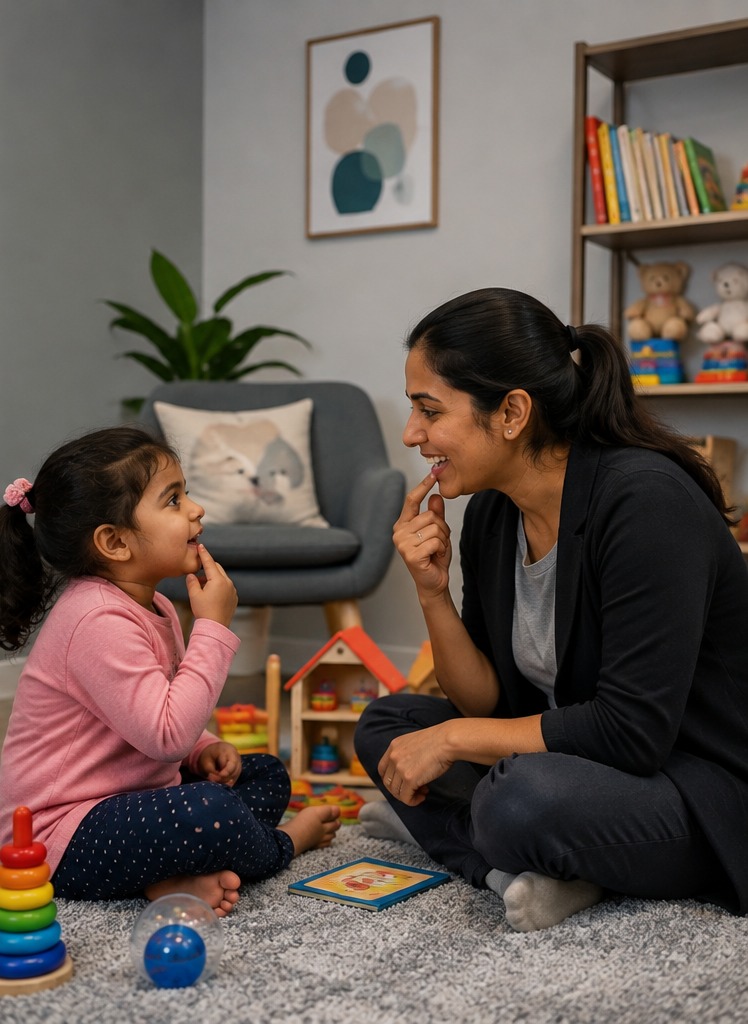
When Should I Look for a Pediatric Speech Pathologist Near Me?
Parents often wonder whether they should wait and see.
Sometimes a child’s communication skills develop later than expected and continue to progress naturally. However, a persistent concern is worth discussing with a qualified professional rather than trying to diagnose the issue yourself.
Speech-Language & Audiology Canada encourages parents to be aware of signs of communication difficulties and seek professional guidance when concerns arise. (SAC-OAC)
Potential reasons to seek an assessment include:
Your child is difficult to understand
Family members may understand a child because they are familiar with their speech, while teachers, relatives or unfamiliar listeners struggle.
That difference can be useful information.
Your child has difficulty following language
For example, they may frequently struggle with age-appropriate instructions or questions.
However, one isolated difficulty does not establish a disorder.
Your child’s vocabulary or sentences seem limited
Children develop at different rates, but persistent concerns about expressive language can be discussed with an S-LP.
Your child stutters
Stuttering can involve repetitions, prolongations, blocks or other disruptions to speech.
A qualified S-LP can help determine whether assessment or support is appropriate.
Your child has difficulty communicating socially
Some children struggle with taking conversational turns, interpreting social cues, maintaining topics or adapting communication to different situations.
Your child has feeding or swallowing concerns
S-LPs can also work with certain feeding and swallowing difficulties.
These cases may require multidisciplinary care, particularly when medical concerns are present.
What Can a Pediatric Speech Pathologist Help With?
The first step is understanding the type of difficulty.
Speech sound disorders
A child may substitute one sound for another, omit sounds or produce sounds inaccurately.
For instance, a child may say one sound when another is expected.
An S-LP can assess the child’s speech sound system and determine which patterns are developmentally expected and which may warrant intervention.
Language difficulties
Language involves more than speaking.
It includes understanding and using words, sentences, grammar and meaning.
A child might have difficulty:
- Following directions
- Learning new vocabulary
- Answering questions
- Telling stories
- Combining words
- Explaining ideas
- Understanding concepts
- Using language in social situations
Fluency difficulties
Stuttering is a fluency difference that can affect the flow of speech.
It can occur in young children as they develop language, while some children experience persistent stuttering.
An S-LP can assess fluency and provide guidance tailored to the child and family.
Social communication
Communication includes knowing how to use language with other people.
Children may need support with:
- Starting conversations
- Maintaining conversations
- Taking turns
- Understanding implied meaning
- Adjusting communication to different people
- Interpreting social information
Voice
Children can experience voice difficulties, including persistent changes in quality, pitch or loudness.
Persistent voice concerns deserve professional assessment.
Augmentative and alternative communication
Some children use communication systems other than, or alongside, speech.
AAC can include gestures, communication boards, pictures, signs or speech-generating technology.
The goal is functional communication.
AAC is not simply a “replacement” for speech. For some children, it can provide an important way to communicate while spoken communication develops or when speech is not sufficient.
Speech Versus Language: Why the Difference Matters
One of the most useful things to understand when searching for a pediatric speech pathologist near me is the difference between speech and language.
Speech generally refers to how we produce spoken sounds.
Language refers to how we understand and communicate meaning.
Consider two examples.
Child A
A child understands stories, follows instructions, uses long sentences and tells detailed stories.
However, some speech sounds are difficult to understand.
This may point primarily toward a speech sound concern.
Child B
A child produces individual sounds clearly but has difficulty understanding questions, learning vocabulary and putting sentences together.
This is more suggestive of a language concern.
Of course, real communication difficulties can involve several areas at once.
That is why assessment matters.
How to Find a Pediatric Speech Pathologist Near Me in Canada
Searching Google for a pediatric speech pathologist near me can produce dozens of results.
But proximity should not be your only criterion.
A better approach is to evaluate location + qualifications + experience + service model + fit.
Start with your province or territory
Professional regulation varies across Canada.
The Government of Canada’s Job Bank identifies speech-language pathology as a regulated occupation in Newfoundland and Labrador, New Brunswick, Quebec, Ontario, Manitoba, Saskatchewan, Alberta and British Columbia. (Job Bank)
Requirements and regulatory arrangements can change, so families should confirm current registration requirements with the appropriate provincial or territorial regulator.
Use a professional directory
Speech-Language & Audiology Canada’s public resources include a Find a Professional directory that allows users to search for S-LPs and audiologists by Canadian province or territory. (SAC-OAC)
This can be a useful starting point when you do not know which clinics operate in your community.
Ask your child’s healthcare provider
A family doctor, paediatrician, nurse practitioner or other healthcare professional may be able to help you understand whether an assessment is appropriate.
Depending on the concern and community, they may also explain available public services.
Check local school resources
If your child attends school, ask the school about available speech-language services.
However, school-based services and private clinical services can have different eligibility criteria, goals and service models.
What Qualifications Should a Canadian S-LP Have?
When choosing a pediatric speech pathologist near me, qualifications should be one of your first checks.
According to the Government of Canada’s Job Bank, speech-language pathologists typically require a master’s degree in speech-language pathology. Registration with a regulatory body is required in several Canadian provinces and territories. (Job Bank)
However, parents should not assume that every professional using a similar job title has the same education.
For example, an S-LP is different from:
- A speech-language pathology assistant
- A communication health assistant
- A developmental worker
- A tutor
- A teacher
- A behavioural therapist
These professionals may all contribute valuable support, but their training and scope of practice differ.
What should you verify?
Before booking, consider asking:
- What is your professional designation?
- Where did you complete your S-LP education?
- Are you currently registered with the applicable regulatory body?
- What age groups do you work with?
- What communication concerns do you commonly assess?
- Do you have experience with my child’s specific concern?
- Do you work with multilingual families?
- Do you offer in-person, virtual or both types of appointments?
These are reasonable questions.
Public Versus Private Pediatric Speech-Language Services
Canadian families may encounter several routes to care.
There is no single service model that is best for every child.
| Factor | Public/community services | Private services |
| Cost | May be publicly funded or subsidized depending on program | Usually fee-based |
| Eligibility | Often program-specific | Usually determined by clinic |
| Wait times | Can vary considerably | May offer different appointment availability |
| Location | Depends on local program | Clinic, home, school or virtual options may exist |
| Assessment | Depends on program | Clinic determines its assessment model |
| Therapy frequency | Depends on capacity and eligibility | Family and clinician may have more scheduling flexibility |
| Insurance | Not usually the central funding mechanism | Some plans may cover eligible services |
| School involvement | May be directly connected to education | Usually requires coordination with school/family |
This table is a general comparison.
Public programmes vary between provinces, territories and communities. Private clinics also vary significantly in their fees, policies and service models.
Therefore, ask the provider exactly how their service works.
What Happens During a Pediatric Speech Assessment?
Parents sometimes feel nervous about an assessment.
In most cases, the purpose is not to “test” a child in the way they might experience a school exam.
The clinician is trying to understand how the child communicates.
An assessment may involve several components.
Parent interview
The S-LP may ask about:
- Developmental history
- Medical history
- Communication milestones
- Languages spoken at home
- School or daycare experience
- Family concerns
- Communication strengths
- Previous assessments or therapy
Your observations are valuable.
Parents see communication across many settings, while a clinician may only see the child for a limited period.
Observation
The clinician may observe how the child interacts, plays, answers questions or communicates.
Younger children may be assessed through play-based activities.
Formal assessment
Depending on the child’s age and concern, the S-LP may use standardised assessment tools.
These can provide structured information about specific communication skills.
However, test scores are not the whole picture.
The clinician may also consider language exposure, cultural context, behaviour during assessment and everyday functioning.
Speech sample
For speech or language concerns, the S-LP may collect examples of the child’s natural communication.
This can reveal patterns that a short test does not capture.
Hearing considerations
Hearing can affect speech and language development.
If hearing has not been checked or there are concerns about hearing, the family may be advised to pursue an audiology assessment.
S-LPs and audiologists have different roles, although they often collaborate.
What Happens After an Assessment?
A good assessment should lead to a clear explanation.
You should ideally understand:
- What the clinician observed
- Which areas are strengths
- Which areas need support
- Whether the findings suggest a communication difficulty
- What recommendations are appropriate
- Whether therapy is recommended
- What parents can do at home
- Whether another professional should be involved
Importantly, not every child who receives an assessment needs weekly therapy.
Sometimes the best recommendation is parent education and monitoring.
Other children may benefit from regular intervention.
The appropriate plan depends on the child’s needs.
How Parents Can Support Speech and Language Development
Searching for a pediatric speech pathologist near me should not mean that every communication activity happens inside a clinic.
Parents and caregivers play a central role in everyday communication.
Talk during ordinary activities
You do not need expensive toys.
Talk about what you are doing while:
- Cooking
- Getting dressed
- Shopping
- Walking
- Bathing
- Playing
- Reading
For example, instead of asking only questions, describe what you see.
“You’re putting the blue block on the tower.”
This gives the child useful language to hear and eventually use.
Read together
Shared reading creates opportunities to discuss pictures, characters, actions and new words.
You can pause and ask simple questions.
However, reading does not have to feel like a quiz.
Conversation is often more useful than repeatedly asking a child to name objects.
Follow your child’s interests
If your child loves trains, use trains to create communication opportunities.
If they love animals, talk about animals.
Motivation can make communication more natural.
Give your child time
After asking a question, allow time for the child to respond.
Adults often answer for children because silence feels uncomfortable.
A short pause can give a child an opportunity to organise a response.
Model rather than constantly correct
If a child says something incorrectly, you can often respond with a natural model.
For example:
Child: “Dog run.”
Adult: “Yes, the dog is running.”
The goal is to provide a useful language model rather than turn every conversation into a correction exercise.
Finding the Right Pediatric Speech Pathologist Near Me
The closest clinician is not always the best match.
Instead, consider five factors.
1. Clinical experience
Does the clinician work with children around your child’s age?
2. Area of expertise
Does the S-LP regularly work with the concern you are seeking help for?
3. Communication style
Do they explain findings clearly?
Parents should be able to ask questions without feeling rushed.
4. Family involvement
Does the clinician explain what you can do between appointments?
5. Practical fit
Consider:
- Location
- Appointment times
- Virtual options
- Fees
- Cancellation policies
- Insurance documentation
- Travel time
A clinically excellent provider may still be difficult to use if appointments are impossible to attend.
Questions to Ask Before Booking
Before choosing a pediatric speech pathologist near me, ask the clinic these questions.
“Do you work with children my child’s age?”
Some clinicians specialise in early childhood, while others primarily work with school-aged children or adults.
“What concerns do you assess?”
Ask specifically about speech sounds, language, stuttering, social communication, AAC, feeding or the concern affecting your child.
“Do you offer an initial consultation?”
Some clinics offer a consultation before a comprehensive assessment.
Ask what is included.
“How long is the assessment?”
Assessment length varies by child and clinic.
“Will I receive a written report?”
If you need documentation for a school, healthcare professional or funding application, ask about the clinic’s reporting process.
“How involved are parents?”
A family-centred approach may include coaching and home activities.
“Do you offer virtual appointments?”
Telepractice can be useful for some families, depending on the child’s age, communication needs, technology and clinical situation.
Costs and Funding in Canada
One of the most common questions after searching pediatric speech pathologist near me is: “How much does it cost?”
There is no single Canada-wide private-practice price.
Fees vary according to:
- Province
- City
- Clinician
- Assessment type
- Appointment length
- Service model
- Report requirements
- In-person versus virtual service
Some public or community services may be funded or subsidised.
Eligibility can vary.
Private services generally charge fees, although some families have extended health insurance coverage.
Ask your insurer
If you have extended health benefits, check:
- Whether speech-language pathology is covered
- Whether there is an annual maximum
- Whether the provider must meet specific requirements
- Whether a physician referral is needed for reimbursement
- Whether assessment and therapy have different coverage
These are administrative questions, not legal advice.
The insurer determines your coverage under your specific plan.
Telepractice and Virtual Speech Therapy
A search for a pediatric speech pathologist near me does not necessarily mean the clinician must be physically nearby.
Some Canadian S-LPs provide services virtually.
Virtual care may be useful for families who:
- Live far from a clinic
- Have transportation challenges
- Need flexible scheduling
- Live in rural or remote communities
- Prefer care from home
However, virtual therapy is not appropriate for every child or every clinical situation.
Age, attention, technology, family availability and the nature of the communication concern all matter.
Ask the S-LP whether they believe virtual assessment or intervention is clinically appropriate.
Bilingual and Multilingual Children
Canada is linguistically diverse.
A child who speaks more than one language should not automatically be assumed to have a language disorder because they use different languages differently.
When searching for a pediatric speech pathologist near me, tell the clinician about every language your child regularly hears or uses.
Include:
- Languages spoken by parents
- Languages used at home
- Languages used at daycare or school
- Approximate exposure to each language
- Which language the child prefers
A child’s communication should be considered in the context of their overall language experience.
If possible, look for an S-LP with experience assessing multilingual children.
SAC specifically provides resources addressing speech-language pathology and audiology in multicultural and multilingual contexts. (SAC-OAC)
Speech-Language Therapy and School Support
School-age children may receive communication support through their educational setting.
However, school-based services and private clinical services are not necessarily interchangeable.
A school team may focus on communication needs that affect participation in education.
A private S-LP may provide a more individualised clinical assessment or intervention plan.
In some cases, collaboration between the family, school and healthcare professionals is helpful.
With appropriate consent and information-sharing procedures, professionals can coordinate their understanding of the child’s needs.
If your child already receives school support, ask how private recommendations can be shared with the school.
Why Early Attention Can Matter
Families sometimes worry that requesting an assessment will “label” their child.
An assessment does not automatically mean that a child has a disorder.
Instead, it provides information.
That information can be reassuring.
It can also identify an area where support may be useful.
Speech-Language & Audiology Canada highlights early identification and intervention as important considerations for childhood communication difficulties. (SAC-OAC)
Still, early intervention should not be interpreted as “earlier is always better regardless of circumstances.”
The right timing depends on the child, the concern, the evidence and the family’s circumstances.
A qualified professional can help you decide what makes sense.
What Makes a Good Pediatric Speech Pathologist?
When comparing providers, look for more than technical qualifications.
A strong clinician should also be able to communicate clearly with families.
They listen
Your observations matter.
They explain
Clinical terminology should be translated into plain language.
They individualise care
A therapy plan should reflect the child’s communication needs and everyday goals.
They involve caregivers
Parents and caregivers can help create opportunities for communication outside therapy.
They collaborate
Children may interact with teachers, physicians, occupational therapists, psychologists, audiologists and other professionals.
Good communication between professionals can support consistent care.
They use appropriate evidence
Clinical decisions should be informed by professional knowledge, evidence and the individual child.
They respect culture and language
Communication should be considered within the child’s family, cultural and linguistic context.
Pediatric Speech Pathologist Near Me: A Practical Search Strategy
Rather than simply typing “pediatric speech pathologist near me” and choosing the first result, try this process.
Step 1: Define your concern
Write down what you are noticing.
For example:
“My four-year-old understands us well but is difficult for people outside the family to understand.”
That is more useful than simply saying “speech delay.”
Step 2: Record relevant history
Note:
- When you first noticed the concern
- Whether it is changing
- Languages spoken
- Previous assessments
- Hearing history
- Relevant medical or developmental information
Step 3: Search local providers
Look at clinics, public services and professional directories.
Step 4: Verify qualifications
Confirm the clinician’s professional designation and applicable registration.
Step 5: Compare service models
Ask about:
- Assessment
- Therapy
- Cost
- Wait time
- Location
- Virtual options
Step 6: Ask about your child’s specific concern
A clinician with experience in your child’s area may be a better fit than a provider chosen solely because they are nearby.
Step 7: Prepare questions
Bring your questions to the initial call or assessment.
Step 8: Review the recommendations
After assessment, make sure you understand the next steps.
This process can make the search less overwhelming.
People Also Ask
How do I find a pediatric speech pathologist near me in Canada?
Start with Speech-Language & Audiology Canada’s professional directory, your provincial or territorial services, healthcare providers and local clinics. Then verify the clinician’s qualifications and applicable professional registration before booking.
At what age should a child see a speech-language pathologist?
There is no single age that applies to every concern. If you have persistent concerns about your child’s communication, it is reasonable to discuss them with a qualified healthcare or speech-language professional rather than relying on a fixed age rule.
Does my child need a doctor’s referral to see an S-LP?
It depends on the service and funding arrangement. Some private clinics accept families directly, while public programmes or insurance plans may have their own administrative requirements.
Are pediatric speech-language pathologists covered by OHIP?
Ontario’s public health insurance system and individual speech-language services are not the same thing. Coverage depends on the service and programme; private S-LP services should not automatically be assumed to be covered by OHIP.
Can speech therapy be done online?
Yes, some S-LPs provide virtual services. However, the clinician should determine whether telepractice is suitable for the child’s age, communication needs and circumstances.
Pediatric Speech Pathologist Checklist
Before booking a provider, use this quick checklist:
- Identify your main concern.
- Write down your child’s age and communication history.
- List every language your child uses or hears.
- Check whether hearing has been assessed when relevant.
- Search for local S-LPs.
- Check professional qualifications.
- Verify applicable provincial or territorial registration.
- Ask about experience with your child’s concern.
- Ask whether assessment is required before therapy.
- Ask about fees and payment policies.
- Check extended-health insurance coverage.
- Ask about public alternatives if cost is a concern.
- Compare in-person and virtual options.
- Ask how parents participate in therapy.
- Confirm what happens after the assessment.
Q&A
Can an S-LP diagnose a speech or language disorder?
S-LPs are trained to assess communication and identify communication disorders within their professional scope. The exact terminology, regulatory framework and documentation requirements can vary by jurisdiction.
For complex developmental or medical concerns, an S-LP may also collaborate with physicians, psychologists, audiologists or other professionals.
What if my child refuses to participate during the assessment?
That is common, particularly with younger children.
A skilled paediatric clinician can often gather information through play, observation, caregiver interviews and other activities.
If a complete assessment cannot be obtained, the S-LP can explain what additional information or follow-up may be needed.
Should I choose a general S-LP or a paediatric specialist?
If your child has a specific concern, relevant paediatric experience can be valuable.
For example, families seeking support for stuttering may prefer an S-LP who regularly works with childhood fluency.
Similarly, families seeking AAC support should ask about the clinician’s experience with communication systems.
How long does speech therapy take?
There is no reliable universal number of sessions.
The duration depends on the child’s needs, goals, response to intervention, attendance, home practice, school environment and other factors.
A responsible clinician should avoid guaranteeing a particular outcome or timeline.
What should I do if I cannot find a provider nearby?
Consider expanding the geographic search, checking public/community programmes and asking about virtual services.
You can also use national and provincial professional directories.
For rural and remote Canadian families, telepractice may sometimes increase access, although suitability needs to be assessed individually.
A Note About Professional Credentials in Canada
Canadian families should be careful with terminology.
“Speech therapist,” “speech-language pathologist,” “S-LP” and “speech pathologist” may appear in search results, but professional titles and regulatory arrangements differ by jurisdiction.
The Government of Canada’s Job Bank confirms that speech-language pathologists typically require a master’s degree in speech-language pathology. It also lists provinces and territories where registration with a regulatory body is required. (Job Bank)
For that reason, checking the applicable regulator is an important administrative step.
This article provides general information only. It is not legal, medical or insurance advice. Families should confirm professional registration, funding eligibility and service requirements with the relevant organisation.
How to Choose With Confidence
Finding a pediatric speech pathologist near me should ultimately be about finding the right professional for your child’s needs, not merely the closest clinic.
Start with the concern.
Then look at qualifications.
Next, consider experience, communication style, service availability and cost.
Finally, ask how the clinician plans to involve your family.
A good provider should be willing to explain what they are assessing, why they are recommending a particular approach and how progress will be monitored.
You should also feel comfortable asking questions.
There is no need to know the correct clinical terminology before your first appointment.
You know your child.
The S-LP brings specialised training.
The best process combines both perspectives.
Conclusion
Searching for a pediatric speech pathologist near me can feel overwhelming, particularly when you are unsure whether your child’s communication development is typical.
Fortunately, Canadian families have several ways to find qualified support.
Start with reputable professional directories, provincial or territorial services and local healthcare resources. Then verify the S-LP’s qualifications and applicable registration. Consider their paediatric experience, clinical focus, approach to family involvement and availability.
Most importantly, remember that an assessment is a way to understand your child’s communication—not a reason to panic.
Speech-language pathologists can support children with a wide range of communication needs, including speech sounds, language, fluency, social communication, voice and, in appropriate cases, feeding and swallowing.
If you are ready to explore child-focused speech and language support, visit Speech For All’s Canadian speech and language resources to learn more about available guidance and services.
The goal is not simply to find the nearest professional. It is to find a qualified clinician who understands your child’s needs and can work with your family toward practical, meaningful communication goals.
Tags: best child speech pathologist near me, best pediatric speech pathologist near me, child speech pathologist near me, child speech therapists near me, pediatric speech language pathologist near me, pediatric speech language therapist near me, pediatric speech language therapy near me, pediatric speech pathologist jobs near me, pediatric speech pathologist near me, pediatric speech therapists near me