

A paediatric speech pathologist helps children build communication, speech, language, social communication, fluency, voice, feeding, and swallowing skills. For families in Canada, finding the right support can feel overwhelming at first. However, once you understand what these professionals do, when to seek help, and how assessment works, the process becomes much easier to manage.
From my experience reviewing family-facing speech and language resources, parents often search for help when something “feels off” but they are not sure whether it is a delay, a normal variation, or something that needs assessment. This guide explains the process in clear Canadian English, with practical steps you can use before, during, and after your first appointment.
Table of Contents
- What is a paediatric speech pathologist?
- Why early support matters
- Speech, language, communication, and feeding explained
- Signs your child may benefit from support
- What a paediatric speech pathologist assesses
- Public, private, school, and virtual options in Canada
- How to find a paediatric speech pathologist in Canada
- Checklist: steps before booking
- What happens during assessment
- Therapy goals and what progress can look like
- Comparison table: service options in Canada
- Questions to ask before choosing a clinician
- People Also Ask
- Expert Q&A
- Conclusion
What is a paediatric speech pathologist?
A paediatric speech pathologist is a regulated communication professional who assesses and treats children with speech, language, communication, fluency, voice, feeding, or swallowing concerns. In Canada, they work with families, doctors, educators, and other providers to help children communicate more clearly and participate more confidently at home, school, and in the community.
What Does a Paediatric Speech Pathologist Do?
A paediatric speech pathologist, also called a speech-language pathologist or SLP, works with infants, toddlers, preschoolers, school-aged children, and teens. Their role is not limited to helping a child “say sounds correctly.” Instead, they look at how a child understands, expresses, uses, and manages communication in real life.
For example, a toddler may need help using first words. A preschooler may need support combining words into sentences. A school-aged child may need help with speech sounds, reading-related language, storytelling, or social communication. Meanwhile, some children may need support with stuttering, voice concerns, feeding, or swallowing.
In Canada, Speech-Language & Audiology Canada notes that early identification and intervention are important because communication is connected to social, emotional, and educational development. Its public guidance also highlights the importance of the first three years for communication growth.
A paediatric speech pathologist may help with:
- Speech sound delays, such as unclear pronunciation
- Language delays, such as limited vocabulary or short sentences
- Receptive language, such as difficulty following directions
- Expressive language, such as trouble explaining ideas
- Stuttering or fluency concerns
- Voice concerns, such as hoarseness
- Social communication and play skills
- Augmentative and alternative communication, often called AAC
- Feeding and swallowing concerns, where within the SLP’s scope
- Communication differences linked to autism, hearing loss, developmental delay, or other diagnoses
However, each child’s needs are different. Therefore, the best therapy plan starts with a careful assessment, not a generic worksheet or one-size-fits-all programme.
Why Early Paediatric Speech Pathologist Support Matters
Parents sometimes hear, “Wait and see.” Sometimes waiting is reasonable. However, if a child is missing expected communication milestones, early guidance can reduce stress and help families understand what to do next.
According to SAC children’s communication guidance, early identification and intervention are key because communication difficulties can affect later learning and family life. This does not mean every late talker will have a long-term disorder. Still, it does mean that parents should not feel embarrassed about asking for help early.
There are three main reasons early support matters.
First, young children learn through daily interaction. Therefore, small changes in how adults talk, pause, respond, and play can create many learning moments throughout the day.
Second, communication affects behaviour. For example, a toddler who cannot ask for help may cry, grab, or avoid tasks. When communication improves, frustration may reduce.
Third, speech and language skills support school readiness. Children use language to follow routines, answer questions, make friends, understand stories, and learn early literacy skills. As a result, a paediatric speech pathologist may support more than speech clarity alone.
Speech, Language, Communication, and Feeding: What’s the Difference?
Many parents use “speech” and “language” as if they mean the same thing. However, they are different.
Speech is the physical act of producing sounds and words. It includes articulation, sound patterns, fluency, and voice. For instance, a child who says “tat” for “cat” may have a speech sound pattern.
Language is the system of understanding and using words, gestures, sentences, and meaning. It includes vocabulary, grammar, comprehension, and storytelling. For example, a child who has many clear sounds but struggles to follow directions may have a language concern.
Communication is broader. It includes gestures, facial expression, turn-taking, eye gaze, play, conversation, social use of language, and AAC. Therefore, a child can communicate even before they speak.
Feeding and swallowing involve how safely and comfortably a child eats and drinks. Some paediatric SLPs have additional training in this area. If your concern is feeding, ask directly whether the clinician assesses feeding and swallowing for your child’s age and needs.
HealthLink BC explains that speech is making the sounds that become words, while language is the system of using words and gestures to communicate and understand others. This distinction helps parents describe concerns more clearly when asking for support.
Signs Your Child May Benefit from a Paediatric Speech Pathologist
Every child develops at their own pace. However, certain signs are worth discussing with a family doctor, public health nurse, school team, or paediatric speech pathologist.
You may consider an assessment if your child:
- Does not respond to sounds or their name consistently
- Uses very few gestures, words, or attempts to communicate
- Loses words or communication skills they previously had
- Is hard to understand compared with peers
- Has trouble following everyday directions
- Uses short or limited sentences for their age
- Repeats sounds, syllables, or words with visible struggle
- Has a hoarse or unusual voice that does not improve
- Avoids talking or becomes frustrated when misunderstood
- Has difficulty chewing, swallowing, or managing textures
- Struggles with conversation, play, or social interaction
- Has school concerns linked to language, listening, reading, or writing
Importantly, one sign alone does not confirm a disorder. Nevertheless, it can justify a screening or assessment. In practice, parents usually know when daily communication is becoming harder than expected. That parent insight is valuable.
What a Paediatric Speech Pathologist Assesses
A paediatric speech pathologist does not only listen to how a child talks. Instead, they gather information from several sources. This may include parent interview, play observation, formal tests, informal language sampling, questionnaires, teacher input, and review of medical or developmental history.
An assessment may look at:
Speech sound production
The clinician checks whether your child can make expected sounds for their age. They may also look for sound patterns, such as leaving off final sounds or replacing one sound with another.
Receptive language
This means what your child understands. The SLP may assess how your child follows directions, understands questions, identifies objects, and processes spoken language.
Expressive language
This means what your child can express. The SLP may look at vocabulary, sentence length, grammar, storytelling, and ability to explain ideas.
Social communication
This includes turn-taking, play, conversation, non-verbal communication, and understanding social context. This area can be especially relevant for autistic children or children with social communication differences.
Fluency
If your child stutters, the SLP may assess types of disfluencies, tension, avoidance, family history, emotional impact, and communication confidence.
Voice
Voice assessment may look at loudness, pitch, quality, vocal strain, and habits. Medical review may be recommended when voice symptoms persist.
Feeding and swallowing
When relevant, a trained paediatric SLP may assess oral-motor skills, chewing, texture tolerance, mealtime behaviour, swallowing safety, and caregiver strategies. Some concerns may require medical referral.
Paediatric Speech Pathologist Services in Canada
In Canada, access can vary by province, territory, city, school board, hospital, and clinic. Therefore, families may see different pathways depending on where they live.
Common options include:
Public health or early intervention programmes
Some provinces and regions offer publicly funded preschool speech and language services. These may be accessed through referral lines, public health, child development programmes, or regional health services. Wait times can vary.
School-based services
School-aged children may receive support through school boards. However, eligibility, frequency, and service model can differ. Some children receive direct therapy, while others receive consultation, classroom strategies, or assessment.
Hospitals and child development centres
Children with medical, developmental, feeding, hearing, or complex communication needs may be seen through hospitals or specialized centres. SickKids, for example, describes communication services that include audiology, speech-language pathology, and auditory verbal therapy, with professionals registered with their regulated colleges.
Private paediatric speech pathology clinics
Private clinics can offer assessment and therapy without the same public wait-list process. However, fees vary, and families may use private insurance, health spending accounts, or direct payment.
Virtual speech therapy
Virtual care can be useful for parent coaching, language therapy, stuttering support, school-aged language work, and some speech sound goals. However, it may not suit every child or concern. For feeding, complex motor speech concerns, or very young children, the clinician may recommend in-person assessment or a hybrid approach.
How to Find a Paediatric Speech Pathologist in Canada
To find a paediatric speech pathologist, start with your child’s main concern and your location. Then check whether the clinician is qualified, registered where required, and experienced with your child’s age group.
In many Canadian jurisdictions, speech-language pathology is regulated. For example, Ontario’s regulatory body, CASLPO, describes itself as the regulator for audiologists and speech-language pathologists in Ontario. Families in Ontario can use the CASLPO public register to confirm registration.
In other provinces, check the relevant provincial regulatory college or association. If you are unsure, ask the clinic which province or territory the SLP is registered in and whether they can provide services to your child’s location.
You can also ask:
- Your family doctor or paediatrician
- Your child’s daycare or school
- Local public health services
- A hospital or child development centre
- A trusted parent support group
- Your insurance provider
- A national or provincial SLP directory
Numbered Checklist: Before Booking a Paediatric Speech Pathologist
Use this checklist before your first call or email.
- Write down your main concern. For example, “My child is hard to understand,” or “My toddler uses only a few words.”
- Note your child’s age and language environment. Include all languages spoken at home. Bilingualism itself does not cause a language disorder, but it matters for assessment planning.
- List medical or developmental details. Include hearing history, diagnoses, prematurity, feeding concerns, school reports, or previous assessments.
- Check registration and qualifications. Ask whether the clinician is a registered speech-language pathologist in the appropriate Canadian jurisdiction.
- Ask about paediatric experience. A clinician may be excellent with adults but not specialize in children. Ask about your child’s age and concern.
- Confirm service type. Ask whether the service is assessment only, direct therapy, parent coaching, school consultation, or a mix.
- Ask about wait times and costs. If private, ask for assessment fees, therapy session fees, cancellation policy, and receipts for insurance.
- Clarify virtual or in-person options. Ask what the clinician recommends and why.
- Prepare examples. Bring videos, notes, daycare comments, teacher concerns, or samples of your child’s speech and language.
- Ask what happens after assessment. You should understand whether you will receive a report, goals, referrals, and a therapy plan.
Comparison Table: Paediatric Speech Pathologist Options in Canada
| Option | Best for | Main benefit | Possible limitation |
| Public preschool speech and language services | Toddlers and preschoolers with early communication concerns | Often publicly funded | Wait times and eligibility vary by region |
| School-based SLP services | Children whose communication affects learning | Connected to classroom needs | Service frequency may be limited |
| Hospital or child development centre | Complex medical, developmental, hearing, feeding, or swallowing needs | Team-based care | Referral rules and wait times may apply |
| Private paediatric speech pathologist | Families wanting faster or more flexible support | Direct access and tailored scheduling | Out-of-pocket cost unless covered by benefits |
| Virtual speech therapy | Parent coaching, language goals, some speech sound or fluency work | Convenient for many families | Not suitable for every child or concern |
| Hybrid care | Children who benefit from both home strategies and in-person support | Flexible and practical | Requires coordination |
What Happens During a Paediatric Speech Pathology Assessment?
The first appointment usually starts with a conversation. The SLP will ask about your child’s development, strengths, concerns, daily routines, languages, hearing, medical history, and family goals.
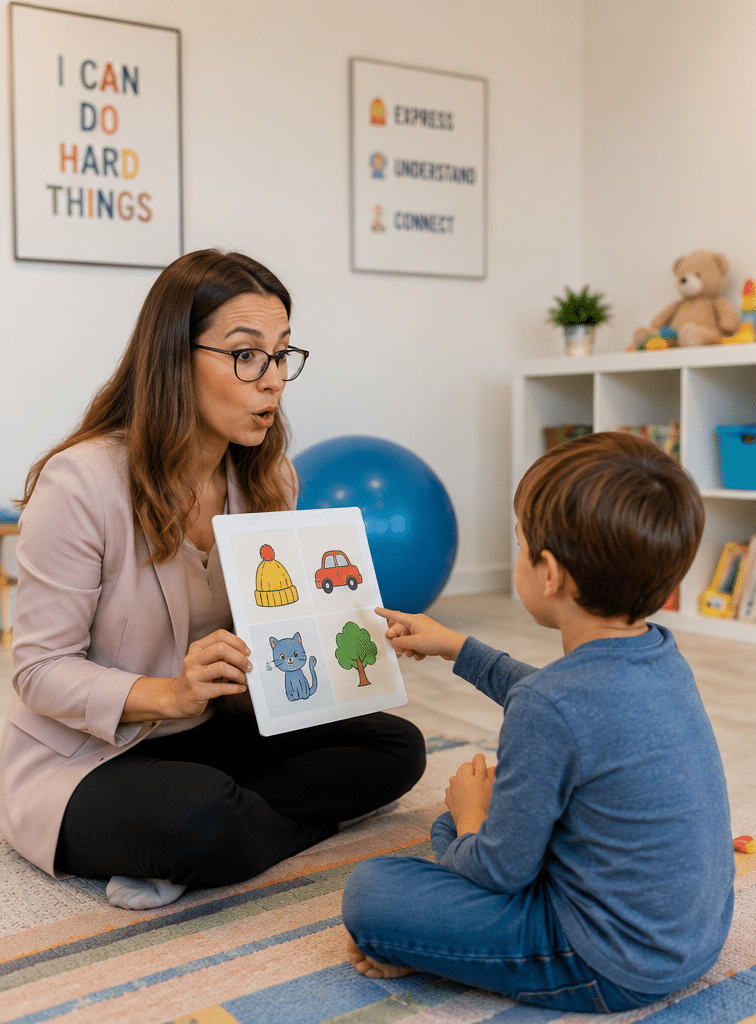
Then, depending on the child’s age, the assessment may include play, conversation, picture-based tasks, story tasks, sound checks, listening tasks, questionnaires, and observation. For young children, it may look like play, but the clinician is watching closely. They are checking how your child requests, responds, imitates, takes turns, follows directions, uses gestures, and combines sounds or words.
Afterward, the SLP should explain findings in plain language. They may describe whether your child’s skills are age-expected, delayed, disordered, or different in a way that needs support. They may also recommend therapy, monitoring, hearing testing, medical referral, school support, or another professional assessment.
A good assessment should answer three questions:
- What is happening?
- Why might it be happening?
- What should we do next?
Therapy Goals: What Progress Can Look Like
Paediatric speech pathology goals should be specific, useful, and connected to daily life. For example, a goal should not only say, “Improve language.” Instead, it may say, “Child will use two-word combinations during play and snack routines,” or “Child will produce final consonants in short phrases with support.”
Progress may look like:
- Your child uses more gestures or words
- Speech becomes easier for familiar people to understand
- Your child follows more directions
- Frustration reduces during routines
- Your child participates more in play
- Stuttering becomes less tense or less feared
- Your child uses AAC more confidently
- Mealtimes become safer or calmer
- Teachers report better classroom participation
However, progress is not always perfectly linear. Children may improve quickly in one area and slowly in another. In addition, home practice matters because communication develops through repeated daily use, not only during clinic sessions.
Parent Coaching and Home Strategies
Many families expect therapy to happen only between the SLP and child. However, parent coaching is often one of the most powerful parts of paediatric speech therapy.
This is because parents and caregivers are present during real communication moments: breakfast, bath time, daycare drop-off, book reading, playground play, and bedtime. When the SLP teaches simple strategies, families can use them many times each day.
Common strategies may include:
- Waiting longer before helping
- Following the child’s lead in play
- Offering simple choices
- Modelling words without forcing repetition
- Expanding what the child says
- Reading interactively
- Using visual supports
- Creating reasons to communicate
- Reducing pressure during speech practice
- Supporting all languages used at home
For example, if your child says “car,” you might say, “Fast car,” or “Car goes up.” This adds language without turning play into a test.
Bilingual and Multilingual Children in Canada
Canada is multilingual, and many children grow up hearing more than one language. Parents sometimes worry that speaking two languages will confuse a child. However, bilingualism itself does not cause a speech or language disorder.
A paediatric speech pathologist should ask about all languages your child hears and uses. They may also ask who speaks each language, how often, and in what settings. This helps separate a true communication concern from normal multilingual development.
If your child has a language disorder, it can appear across languages, although it may look different in each one. Therefore, families should not drop a home language without professional reason. Home languages support family connection, identity, and everyday communication.
Autism, AAC, and Neurodiversity-Affirming Support
Some children who see a paediatric speech pathologist are autistic or have other developmental differences. In these cases, therapy should not aim to erase a child’s personality or force unnatural communication. Instead, it should support meaningful, respectful communication.
AAC, or augmentative and alternative communication, may include gestures, pictures, communication boards, speech-generating devices, or apps. AAC does not prevent speech. Rather, it gives children more ways to communicate while speech and language continue to develop.
A balanced paediatric SLP approach focuses on:
- Understanding the child’s communication style
- Supporting regulation and comfort
- Respecting sensory needs
- Building functional communication
- Helping communication partners respond better
- Encouraging connection, not forced performance
Costs, Insurance, and Administrative Considerations
Private paediatric speech pathology fees in Canada vary by province, clinic, assessment type, report needs, and session length. Any cost estimate should be checked directly with the provider because fees change.
Many families ask whether services are covered. Coverage may come from public programmes, school systems, employee benefits, private insurance, or health spending accounts. However, coverage rules differ.
Administrative tasks may include:
- Getting a referral, if required
- Checking insurance eligibility
- Asking for receipts with the clinician’s registration details
- Requesting reports for school or daycare
- Completing intake forms
- Sharing consent for communication with other providers
This is administrative guidance only, not legal or insurance advice. Always confirm coverage and claim rules with your provider, employer, insurer, or relevant public programme.
Questions to Ask a Paediatric Speech Pathologist Before Starting
Before you choose a provider, ask practical questions. This helps you avoid confusion later.
Good questions include:
- Are you registered to practise in my province or territory?
- Do you work with children my child’s age?
- Do you assess my child’s specific concern?
- Do you provide therapy after assessment?
- Will I receive a written report?
- How do you involve parents or caregivers?
- Do you offer in-person, virtual, or hybrid sessions?
- What does home practice usually look like?
- How often are goals reviewed?
- What are your fees and cancellation policies?
- Can you coordinate with daycare, school, or other professionals?
A confident provider should explain these answers clearly. Also, they should tell you when another service or referral may be more appropriate.
Common Mistakes Parents Should Avoid
The first mistake is waiting too long when concerns are persistent. While some children catch up, an assessment can help you make an informed decision.
The second mistake is focusing only on speech clarity. A child may pronounce words clearly but still struggle with understanding, grammar, social communication, or storytelling.
The third mistake is comparing siblings too closely. Siblings develop differently. However, major differences can still be worth checking.
The fourth mistake is assuming therapy should be difficult to be effective. Children often learn best through motivating, playful, and meaningful routines.
The fifth mistake is ignoring hearing. Hearing difficulties can affect speech and language development. Therefore, hearing checks are often part of the broader pathway.
People Also Ask: Paediatric Speech Pathologist Canada
1. When should I take my child to a paediatric speech pathologist?
You should consider support if your child is not meeting communication milestones, is hard to understand, has trouble following directions, stutters, loses skills, or becomes frustrated when communicating. If you are unsure, a screening or consultation can help you decide whether full assessment is needed.
2. Do I need a doctor’s referral for a paediatric speech pathologist in Canada?
It depends on the service. Some public programmes or hospital clinics may require a referral, while many private paediatric speech pathologists accept direct bookings from parents. Always check the intake rules for your province, clinic, school board, or local programme.
3. Is a paediatric speech pathologist the same as a speech therapist?
In everyday language, many people say “speech therapist.” In Canada, the professional title is commonly speech-language pathologist, often shortened to SLP. A paediatric speech pathologist is an SLP who works with children.
4. Can a paediatric speech pathologist help toddlers who are not talking?
Yes, many paediatric SLPs work with late talkers and toddlers with limited words. Therapy may include parent coaching, play-based strategies, gesture support, early words, turn-taking, and routines that create more chances for communication.
5. Can speech therapy be done online for children?
Yes, online therapy can work well for some children and goals, especially when parents are actively involved. However, in-person assessment may be better for some feeding, swallowing, motor speech, attention, or complex developmental concerns.
Expert Q&A: Paediatric Speech Pathologist Guidance
1. What should I bring to my child’s first paediatric speech pathologist appointment?
Bring any reports, hearing test results, school or daycare notes, medical details, and examples of your concern. Short videos can be helpful because they show how your child communicates in familiar settings. Also, write down your top three questions so you do not forget them during the appointment.
2. How long does paediatric speech therapy take?
Therapy length depends on your child’s needs, age, diagnosis, goals, attendance, and home practice. Some children need a short block of support, while others benefit from longer-term therapy. A good paediatric speech pathologist should review progress regularly and adjust the plan.
3. Will my child grow out of a speech or language delay?
Some children catch up, but others need targeted support. It is difficult to know without assessment because delays can have different causes. Therefore, if concerns are affecting daily communication, it is safer to ask for guidance than to rely only on waiting.
4. What is the difference between a paediatric speech pathologist and an occupational therapist?
A paediatric speech pathologist focuses on communication, speech, language, fluency, voice, AAC, and sometimes feeding and swallowing. An occupational therapist often supports daily living skills, fine motor skills, sensory processing, regulation, and participation. Many children benefit from both, depending on their needs.
5. How can I support speech therapy at home without pressuring my child?
Use short, natural practice during routines your child already enjoys. For example, model words during play, read interactively, pause to let your child respond, and praise communication attempts. Avoid constant testing, because children usually communicate more when they feel connected and relaxed.
Conclusion: Finding the Right Paediatric Speech Pathologist in Canada
A paediatric speech pathologist can help families understand a child’s communication strengths, identify areas of need, and create a practical plan for support. In Canada, families may access help through public programmes, schools, hospitals, private clinics, or virtual services. However, the right pathway depends on your child’s age, concern, location, and service availability.
Most importantly, you do not need to wait until a concern becomes severe. If communication is affecting your child’s confidence, learning, behaviour, feeding, or family routines, it is reasonable to ask for help. For family-friendly guidance and support options, visit paediatric speech and language support in Canada.
Tags: paediatric speech pathologist, paediatric speech pathologist adelaide, paediatric speech pathologist brisbane, paediatric speech pathologist canberra, paediatric speech pathologist gold coast, paediatric speech pathologist jobs, paediatric speech pathologist near me, paediatric speech pathologist perth, paediatric speech pathologist salary, paediatric speech pathologist toowoomba