

When parents search for a child speech therapist near me, they are usually looking for more than a nearby clinic. They want to know whether their child needs support, what type of professional to contact, how an assessment works, how long therapy may take, and whether services are available through public programs, schools, private clinics or virtual care. This guide uses current Canadian professional and public-health information to help families understand those choices without making assumptions about an individual child’s development.
Children develop communication skills at different rates. Therefore, a child who speaks differently from another child of the same age does not automatically have a speech or language disorder. However, persistent difficulty being understood, understanding language, combining words, speaking fluently or participating in conversations may be worth discussing with a qualified speech-language pathologist.
In Canada, the professional term you will commonly see is speech-language pathologist, often shortened to SLP or S-LP. “Speech therapist” is a common phrase families use when searching online, but the professional titles and regulatory requirements vary by jurisdiction.
What Does “Child Speech Therapist Near Me” Mean?
A child speech therapist near me search helps families find a local speech-language pathologist who assesses and supports children’s speech, language, communication, fluency and related needs. In Canada, parents should consider the therapist’s professional registration, paediatric experience, location, service model, family involvement and whether in-person or virtual care best suits their child.
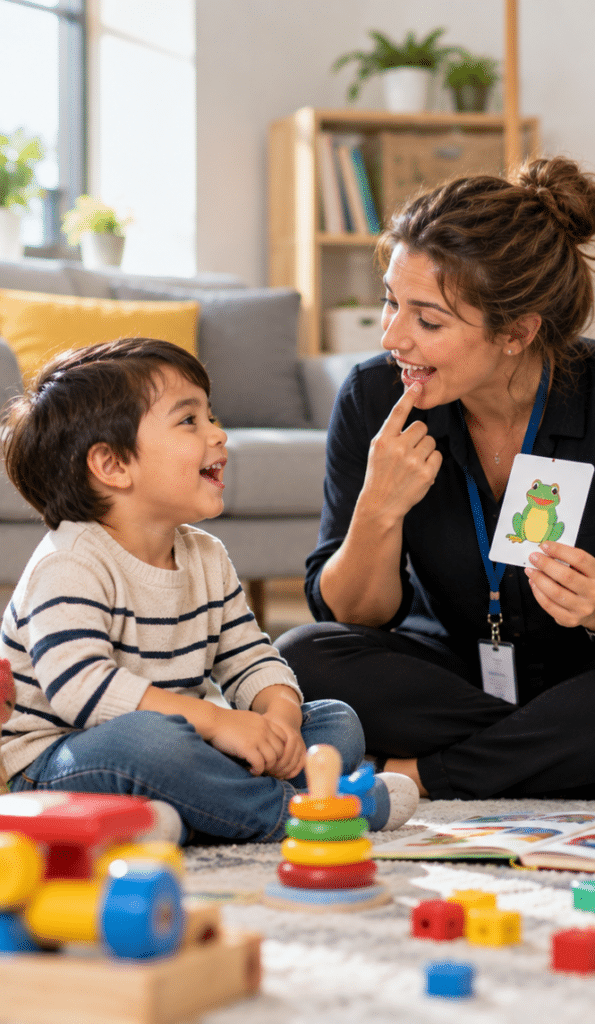
Table of Contents
- What a child speech therapist does
- Speech versus language difficulties
- Signs that may justify an SLP consultation
- Why hearing should also be considered
- How to find a child speech therapist near me in Canada
- How Canadian speech-language services are accessed
- Public, private and school-based options
- What happens during a speech-language assessment
- What children’s speech therapy may involve
- How to choose the right SLP
- Preparing for the first appointment
- Supporting communication at home
- Multilingual children and speech-language assessment
- Virtual versus in-person therapy
- Questions about cost and insurance
- People Also Ask
- Child speech therapist near me Q&A
- Conclusion
What Does a Child Speech Therapist Do?
A speech-language pathologist is a communication health professional trained to assess and support speech, language, voice, fluency and other communication difficulties. Speech-Language & Audiology Canada explains that SLPs work with communication disorders and that common childhood concerns can include articulation difficulties, language difficulties, stuttering and voice problems.
Families can learn more about the profession through Speech-Language & Audiology Canada’s public resources.
A paediatric SLP may work with children who have difficulty with:
- producing particular speech sounds;
- being understood by family members, teachers or peers;
- understanding spoken instructions;
- learning and using new words;
- combining words into sentences;
- telling stories or explaining events;
- participating in back-and-forth conversations;
- speaking fluently;
- using their voice comfortably;
- social communication;
- communicating through alternative or augmentative communication systems when appropriate.
Importantly, speech therapy is not simply practising sounds repeatedly. The SLP first needs to understand why communication is difficult and how that difficulty affects the child’s participation in daily life.
For example, two children may both have difficulty saying a particular sound. However, one child might be easily understood in conversation while another may be difficult for unfamiliar listeners to understand. Their therapy priorities may therefore be different.
Speech and Language Are Not the Same Thing
When someone searches for a child speech therapist near me, the concern is not always strictly about speech.
Speech generally refers to how sounds and words are physically produced. A speech difficulty may affect pronunciation, fluency or voice.
Language, by contrast, involves understanding and expressing meaning.
Receptive language refers to what a child understands. Expressive language refers to how the child communicates thoughts, needs and ideas using words, sentences, gestures or other communication methods.
For example, a child may pronounce words clearly but have difficulty understanding longer instructions. Another child may understand language well but struggle to produce certain sounds.
Because these issues can look similar to parents at first, a professional assessment can help identify the child’s communication strengths and areas requiring support.
When Should I Search for a Child Speech Therapist Near Me?
There is no single symptom that proves a child requires speech therapy. Development also varies from child to child.
However, parents may consider discussing communication development with an SLP or another appropriate health professional when they notice persistent concerns such as:
- very limited communication compared with what the family expects for the child’s developmental stage;
- difficulty understanding everyday language;
- frequent frustration when trying to communicate;
- speech that is difficult for familiar or unfamiliar listeners to understand;
- noticeable repetition, blocking or struggle while speaking;
- persistent hoarseness or unusual voice quality;
- difficulty learning or using new words;
- difficulty putting words together;
- reduced participation in conversations or play because communication is difficult;
- loss of communication abilities the child previously used.
Speech-Language & Audiology Canada advises families who suspect a communication problem to contact an SLP or audiologist and emphasises early identification.
Developmental milestones can provide useful reference points, but they should not be treated as a pass-or-fail test.
For example, HealthLink BC notes that by around 24 months many children use at least 50 words and begin combining two words. At the same time, it explicitly notes that children reach milestones at different ages.
Therefore, if your child does not match a single milestone exactly, that alone does not establish a disorder. The broader pattern of development matters.
Why Hearing Matters When a Child Has Speech or Language Difficulties
Parents searching for a child speech therapist near me may not immediately think about hearing. However, access to sound plays an important role in spoken-language development.
HealthLink BC explains that hearing difficulties can contribute to speech and language delays and recommends hearing assessment when a child has speech-language delays.
A child can sometimes respond to many everyday sounds and still have a hearing issue that affects access to particular sounds or situations. Therefore, simply observing that a child “can hear me” does not necessarily replace a professional hearing assessment when one is recommended.
Parents can review general developmental information through HealthLink BC’s speech and language development resource.
An SLP may suggest discussing hearing with an audiologist, family doctor, nurse practitioner or other appropriate health professional depending on the child’s needs and local care pathway.
How to Find a Child Speech Therapist Near Me in Canada
Searching online is a reasonable first step, but proximity should not be your only selection criterion.
A good local search should answer several questions:
- Is the professional appropriately registered where required?
- Do they regularly work with children of your child’s age?
- Do they have experience with the specific communication concern?
- Do they involve parents or caregivers in therapy?
- Are services offered in a language that works for your family?
- Is the location practical for repeated appointments?
- Would virtual therapy be appropriate if travel is difficult?
- Are assessment, report and treatment fees clearly explained?
- What happens after the assessment?
- How long is the current waiting period?
Speech-Language & Audiology Canada maintains a national member directory that allows families to search by location and other criteria.
However, association membership and regulatory registration are not the same thing. SAC states that speech-language pathology is regulated in Canadian provinces, while regulatory arrangements differ in the territories.
Therefore, families should also check the relevant regulatory body for their province when applicable.
For example, Ontario requires individuals practising as speech-language pathologists to be registered with the College of Audiologists and Speech-Language Pathologists of Ontario. Its public register includes professional registration information and additional details intended to help protect the public.
Families in Ontario can use the CASLPO public register to verify an SLP.
Families outside Ontario should use the appropriate regulator for their own province rather than assuming Ontario requirements apply nationally.
Child Speech Therapist Near Me: Public, Private and School-Based Options
The Canadian care pathway depends heavily on your province or territory, your child’s age, eligibility criteria and local service availability.
You may encounter several options.
| Service pathway | Common features | Potential advantages | Questions to ask |
| Public/community program | Government or publicly funded service | May reduce direct family cost | Eligibility? Referral needed? Waiting time? |
| Private SLP clinic | Family contacts provider directly | More choice of provider or scheduling may be available | Assessment fee? Therapy fee? Insurance coverage? |
| School-based service | Support connected with school system | Communication goals may be linked to classroom participation | Who qualifies? How are services delivered? |
| Children’s treatment centre | Multidisciplinary services may be available | Can support children with broader developmental needs | Referral process? Catchment area? |
| Virtual speech therapy | Sessions delivered remotely | Useful when travel or geography is difficult | Is virtual care suitable for the child’s needs and age? |
The exact structure is not the same across Canada.
Ontario, for example, operates a Preschool Speech and Language Program for children from birth until school entry. Ontario states that families can register when they have concerns about speech or language development and that a doctor’s referral is not required for that specific program.
That is an Ontario example rather than a Canada-wide rule.
Current Ontario program guidance also describes assessment, intervention, early support and transitions as parts of its service model.
Consequently, when searching for a child speech therapist near me, check both private providers and the public services available in your own region.
What Happens During a Child Speech-Language Assessment?
A speech-language assessment is designed to understand the child’s communication abilities in context.
The exact process depends on age, concern and provider. However, it may involve several components.
1. Parent or caregiver interview
The SLP may ask about:
- communication development;
- languages used at home;
- medical and developmental history;
- hearing history;
- family concerns;
- preschool or school participation;
- communication strengths;
- situations that are particularly difficult.
This information matters because communication happens in real environments, not only in a therapy room.
2. Observation
For younger children, observation through play can provide valuable information.
The clinician may observe how the child:
- requests objects;
- responds to others;
- follows directions;
- uses gestures;
- takes turns;
- combines words;
- produces speech sounds;
- communicates when misunderstood.
3. Structured activities
When appropriate, the SLP may use formal or informal assessment activities.
These could examine areas such as:
- speech sound production;
- vocabulary;
- sentence structure;
- comprehension;
- narrative skills;
- fluency;
- voice;
- social communication.
4. Functional impact
An assessment should not focus only on scores.
For example, a speech sound difference may have greater clinical importance when it prevents the child from being understood at school, avoiding social participation or communicating important needs.
5. Recommendations
After assessment, the SLP may recommend:
- monitoring;
- parent strategies;
- direct therapy;
- a home program;
- group support;
- consultation with educators;
- further hearing assessment;
- assessment or involvement from another professional where appropriate.
A recommendation for another professional does not necessarily mean something serious has been found. Communication development can intersect with hearing, development, learning, feeding and other areas, so collaborative care may be useful.
What Does Children’s Speech Therapy Look Like?
Therapy should be linked to meaningful communication goals.
For one child, the goal may be producing a particular sound more clearly. For another, the priority might be following classroom instructions, increasing useful vocabulary or building longer sentences.
Younger children’s therapy may include play-based activities. Parents may also be taught strategies to use during routines such as meals, bath time, dressing, reading or play.
This matters because a weekly appointment represents only a small part of a child’s week. Opportunities to communicate throughout ordinary routines can help children practise skills in natural settings.
Ontario’s public Preschool Speech and Language Program, for example, describes approaches that may include parent education, small groups, consultation and home programs in addition to direct professional involvement.
Therefore, families should not assume that “good speech therapy” must always mean the therapist works alone with the child for an entire session.
Parent coaching can be an important part of intervention.
A 10-Step Checklist for Choosing a Child Speech Therapist Near Me
Use this checklist before booking ongoing therapy.
- Identify your main concern. Write down what you are noticing and when it happens.
- Search for qualified SLPs. Use trusted professional directories, regulators, health systems and local health services.
- Check professional registration. Use your province’s regulatory register where applicable.
- Ask about paediatric experience. Confirm that the clinician regularly works with children of your child’s age.
- Describe the concern before booking. Ask whether the SLP commonly assesses that area.
- Ask how assessment works. Find out the approximate appointment structure and whether a written report is included.
- Discuss language needs. Tell the provider which languages your child hears and uses.
- Understand the treatment model. Ask whether therapy involves direct sessions, parent coaching, home activities or a combination.
- Clarify administrative details. Ask about fees, cancellations, receipts, insurance paperwork and waiting periods.
- Review fit after the first appointments. You should understand the goals, why they were selected and what you can do between appointments.
Administrative questions about benefits, public funding or reimbursement should be confirmed directly with the relevant provider, insurer, employer plan or government program. Requirements vary, and clinic staff should not be treated as a substitute for professional financial or legal advice.
Questions to Ask Before Booking
A parent searching for a child speech therapist near me can save time by asking a few questions before the first appointment.
Consider asking:
- Do you regularly work with children this age?
- Do you assess the specific issue I am concerned about?
- What should we bring to the appointment?
- How long is the initial assessment?
- Will we receive written recommendations?
- Do you involve parents in therapy?
- Do you communicate with teachers or other professionals when appropriate and authorised?
- Is virtual therapy available?
- What happens if you believe another assessment is required?
- Are there separate charges for reports, forms or consultations?
- Do you issue receipts that families can submit to eligible benefit plans?
Clear answers help families compare services based on quality and practical fit rather than choosing solely by distance.
Preparing Your Child for the First Appointment
Parents do not need to coach their child to “perform well” before an assessment.
The purpose is to understand how communication currently works.
Instead, prepare useful background information.
You may want to bring:
- a list of your main concerns;
- examples of words or sounds that are difficult;
- relevant hearing information;
- previous speech-language reports;
- relevant school or preschool information;
- a list of languages used regularly;
- questions you want the SLP to answer.
For young children, bringing a familiar object may be helpful if the clinic allows it.
Also, describe what communication looks like on both good and difficult days. A short clinic visit cannot capture every situation a child experiences at home, school and in the community.
Supporting Speech and Language at Home
Parents often ask whether they should practise constantly between appointments.
Usually, communication support works better when it fits naturally into everyday interaction rather than making every conversation feel like a test.
Useful general strategies can include:
Follow your child’s interests
If your child is focused on toy cars, animals or cooking, use that activity as an opportunity for conversation.
Model language rather than demanding repetition
If a child says, “Dog run,” a parent might respond naturally with, “Yes, the dog is running!”
This provides a slightly more advanced model without turning the exchange into a quiz.
Give time to respond
Children may need additional processing time.
Ask a question or make a comment, then allow the child an opportunity to respond rather than immediately answering for them.
Read together
Shared reading creates opportunities to hear vocabulary, predict events, describe pictures and discuss characters.
Reduce unnecessary correction
Repeatedly telling a child that every word was “wrong” can make communication frustrating.
If an SLP provides a specific home practice plan, follow that plan instead of trying to correct every speech difference during everyday conversation.
Most importantly, general strategies do not replace individualised assessment when a child has persistent communication difficulties.
Multilingual Children and Speech Therapy in Canada
Canada is highly multilingual, so families frequently wonder whether speaking more than one language causes speech delays.
Using multiple languages does not, by itself, mean a child has a communication disorder.
For an accurate assessment, the SLP needs to understand the child’s exposure to and use of each language.
Therefore, tell the clinician:
- which languages family members speak;
- which language the child hears most often;
- which language the child uses at childcare or school;
- whether communication difficulties occur in one language or several;
- whether an interpreter may be needed.
Families should not automatically stop using a home language because of speech-language concerns unless a qualified professional familiar with the child’s circumstances has provided a clear reason.
A child’s home language can be important for family relationships, cultural participation and everyday communication.
Virtual or In-Person Child Speech Therapist Near Me?
The word near me no longer always means physically nearby.
Some Canadian families use virtual speech-language services because of geography, transportation, scheduling or provider availability.
Neither virtual nor in-person therapy is automatically better for every child.
| Factor | In-person therapy | Virtual therapy |
| Travel | Requires travel | Can reduce travel |
| Home involvement | Parent may observe or participate | Parent often plays an active role |
| Technology | Minimal | Reliable device/internet usually needed |
| Materials | Clinic materials available | Home materials may be incorporated |
| Suitability | Useful for many assessment and treatment needs | Suitability depends on child, goal and service |
| Geographic access | Limited by travel distance | May increase access, subject to professional practice requirements |
Ask the SLP whether virtual care is clinically appropriate for your child’s goals.
Also confirm that the professional can legally and professionally provide services where your child is located. Cross-jurisdiction practice requirements can differ.
How Much Does a Child Speech Therapist Cost in Canada?
There is no single Canada-wide private speech therapy price.
Fees can vary according to:
- province and city;
- assessment type;
- appointment length;
- clinician or clinic;
- whether a written report is included;
- therapy format;
- additional consultation or documentation.
Because prices change and private clinics set their own fees, families should request current pricing directly from the clinic rather than relying on old online estimates.
Ask for separate information about:
- initial consultation;
- assessment;
- therapy sessions;
- written reports;
- school meetings;
- forms;
- missed appointments.
Some families may have access to public programs, workplace health benefits or private insurance. However, eligibility and reimbursement conditions vary.
Therefore, verify coverage with the relevant program or insurer before assuming an expense will be reimbursed.
People Also Ask About a Child Speech Therapist Near Me
How do I know whether my child actually needs speech therapy?
A single missed milestone does not automatically mean a child needs therapy. However, ongoing difficulty communicating, understanding language, producing speech clearly or participating because of communication concerns is a reasonable reason to seek an SLP consultation.
Do I need a doctor’s referral for a child speech therapist in Canada?
It depends on the service. Some private clinics accept self-referrals, while public programs may have their own access requirements. Ontario’s Preschool Speech and Language Program, for example, states that a doctor’s referral is not required for that specific program.
What age should a child see a speech-language pathologist?
There is no universal minimum age for discussing communication concerns. SLP services can support very young children when clinically appropriate, and parents do not need to wait for a child to reach school age before asking questions.
Can a speech therapist help a child who understands language but cannot pronounce sounds clearly?
Potentially, yes. Speech sound production is one area SLPs assess. However, an assessment is needed to understand which sounds are affected, whether the pattern is developmentally expected and how much it interferes with communication.
Should my child’s hearing be checked if speech is delayed?
Hearing should be considered because access to sound can affect speech and spoken-language development. HealthLink BC specifically advises hearing assessment for children with speech and language delays.
Child Speech Therapist Near Me: Detailed Q&A
1. What is the difference between an SLP and a communication assistant?
A speech-language pathologist is the professional responsible for assessment, clinical decision-making and treatment planning within their scope of practice.
Communication health assistants may support treatment under professional supervision. Speech-Language & Audiology Canada notes that assistants may help deliver treatment and follow plans developed by an SLP.
Therefore, families should understand who performed the assessment, who established the goals and how supervision works if an assistant participates in therapy.
2. How can I tell whether a speech therapist is properly qualified?
Check the professional’s full name and credentials. Then verify registration with the appropriate provincial regulatory body where the profession is regulated.
Do not rely only on social media profiles, advertising claims or the word “therapist”. The professional register is a more authoritative way to verify status.
3. What if the nearest child SLP has a long waiting list?
Ask whether the clinic offers cancellations, group programs, parent coaching, virtual appointments or another qualified clinician with earlier availability.
At the same time, investigate public or community options available in your region. Families do not necessarily need to limit themselves to a single waiting list.
4. Should parents attend speech therapy sessions?
Parent involvement is often useful, particularly for younger children, because parents can apply communication strategies throughout the week.
However, the appropriate level of involvement depends on the child’s age, goals, service model and clinician’s recommendations. Ask the SLP how caregivers will participate and what is expected between appointments.
5. How will I know whether therapy is working?
Before ongoing treatment begins, ask the clinician to explain the goals in everyday language.
Progress might involve clearer speech, greater vocabulary, better understanding, longer sentences, easier participation or another meaningful functional change. The SLP should periodically review progress and modify goals when needed rather than continuing the same plan indefinitely without explanation.
Final Thoughts: Finding the Right Child Speech Therapist Near Me
Searching for a child speech therapist near me is often the beginning of a larger decision about how best to support a child’s communication.
Start by identifying your main concern. Then look for an appropriately qualified speech-language pathologist with relevant paediatric experience. Check professional registration where applicable, discuss hearing when appropriate, and compare public, private, school-based and virtual options available in your part of Canada.
Most importantly, focus on the child’s everyday communication rather than a single milestone or test score. Good assessment considers strengths as well as difficulties and should result in practical recommendations that families understand.
Parents should also feel comfortable asking why a particular goal or therapy approach has been recommended. Speech-language support should be collaborative, family-centred and connected to communication that matters in real life.
If you are looking for practical information and support for your child’s communication needs, you can explore child speech and language support at Speech for All and discuss the next appropriate step for your family.
Tags: baby speech therapist near me, baby speech therapy near me, child speech therapist near me, child speech therapy near me, children's speech pathology near me, kids speech therapy near me within 5 mi, pediatric speech therapist near me, pediatric speech therapy near me, toddler speech therapist near me, toddler speech therapy near me