

If you searched speech pathologist autism, you may be trying to understand whether a speech-language pathologist, often called an SLP, can help an autistic child, teenager, or adult communicate more effectively and comfortably. In Canada, SLPs support many areas beyond pronunciation. Depending on a person’s needs, they may assess language, speech, social communication, augmentative and alternative communication (AAC), literacy, and communication participation.
Autism is a lifelong neurodevelopmental condition, and there is no single communication profile that applies to every autistic person. Some people communicate mainly through speech. Others use gestures, writing, sign, pictures, speech-generating devices, or several methods together. Some speak fluently but still find certain communication situations demanding.
Therefore, good speech-language support begins with the person rather than a predetermined therapy program. Goals should reflect what matters in daily life, whether that means asking for help, expressing opinions, participating in school, communicating at work, using AAC more independently, or making conversations less exhausting.
The Government of Canada’s autism framework similarly emphasizes individualized, neuro-affirming support and recognizes that needs differ greatly between autistic people and across life stages.
What Does a Speech Pathologist Do for Autism?
A speech pathologist supporting an autistic person assesses how they understand, express, and use communication in daily life. Support may include spoken language, speech clarity, social communication, AAC, literacy, or communication-partner coaching. Goals should be individualized, functional, respectful of neurodiversity, and focused on participation rather than making someone appear less autistic.
Table of Contents
- What speech pathologist autism support means
- How autism can affect communication
- When to consider a speech-language assessment
- What happens during a speech pathologist autism assessment
- Common therapy and communication goals
- AAC and autism communication support
- Neurodiversity-affirming speech-language therapy
- Speech pathology compared with other autism supports
- Accessing speech-language services in Canada
- Choosing a speech pathologist for autism
- People Also Ask
- Expert Q&A
- Conclusion
What Does Speech Pathologist Autism Support Actually Involve?
A speech-language pathologist is a health professional trained to assess and support communication and, within relevant areas of practice, feeding and swallowing.
Speech-Language & Audiology Canada explains that SLPs work with people across the lifespan on areas including speech, language, social communication, literacy, AAC, feeding, and swallowing. Communication differences related to neurodevelopmental conditions are also within the profession’s broad scope.
Speech-Language & Audiology Canada information about speech-language pathology
However, speech pathologist autism support does not mean there is a standard “autism speech therapy” program that every autistic person should complete.
Instead, the SLP first needs to understand the person’s communication profile.
For example, one autistic child might use many words but struggle to explain what happened during their school day. Another may understand more language than they can express verbally. A teenager may communicate well with familiar people but find group conversations overwhelming. An adult may speak fluently yet need more reliable ways to communicate during periods of stress, sensory overload, fatigue, or shutdown.
Therefore, assessment should ask a practical question:
What would make communication easier, more effective, or more accessible for this individual?
That question often produces more useful goals than simply asking whether someone’s communication looks typical.
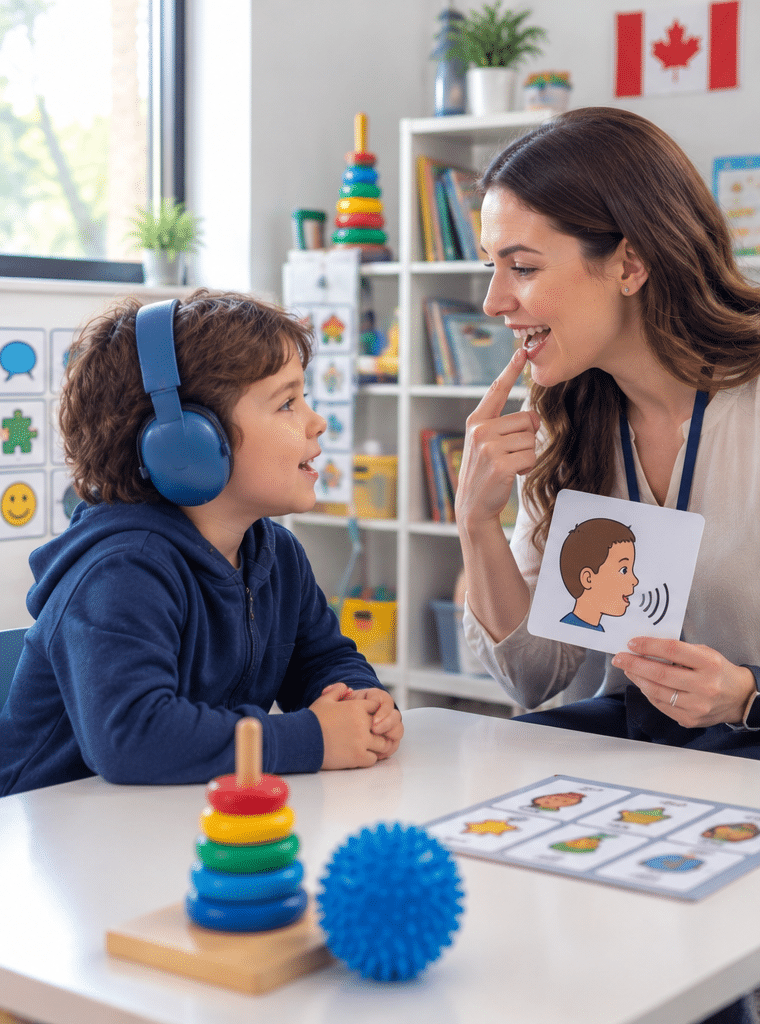
How Autism Can Affect Communication
Autism does not automatically mean that a person has a speech disorder.
Instead, autistic people can have many different combinations of communication strengths and support needs.
According to the Government of Canada, autistic people may communicate and interact differently, experience sensory processing differences, or have focused interests and activities. The type and level of support needed can vary substantially from person to person.
Receptive language
Receptive language means understanding communication from other people.
A person may have difficulty with:
- lengthy spoken instructions
- abstract language
- unfamiliar vocabulary
- rapidly delivered information
- implied meanings
- figurative language
- questions with several parts
- processing speech in noisy environments
However, slower responses should not automatically be interpreted as poor understanding.
Processing time, sensory conditions, anxiety, motor planning, attention, unfamiliar communication partners, and the format used to present information may all affect performance.
Therefore, a speech pathologist autism assessment may explore how understanding changes when information is presented verbally, visually, in writing, through demonstration, or with additional processing time.
Expressive language
Expressive language is how someone communicates thoughts, needs, questions, emotions, opinions, and information.
An autistic person may use:
- spoken language
- gestures
- facial expressions
- writing or typing
- signs
- picture-based systems
- a communication application
- a dedicated speech-generating device
- combinations of several methods
An important principle is that successful communication does not have to mean speech alone.
The goal is reliable communication.
Speech production
Some autistic people also have separate speech production difficulties.
These may involve:
- articulation
- speech sound development
- motor speech
- voice
- fluency
- speech intelligibility
An SLP should determine whether a difficulty is related primarily to language, speech production, motor planning, communication context, or several factors together.
That distinction matters because the treatment approach may be very different.
Social communication
Social communication describes how communication works between people in real situations.
This may include:
- starting or ending conversations
- knowing when clarification is needed
- repairing misunderstandings
- understanding another person’s intended meaning
- communicating boundaries
- asking for information
- joining a group interaction
- explaining a different perspective
- self-advocating
However, social communication therapy requires care.
The goal should not automatically be to teach autistic people to imitate non-autistic body language, force eye contact, suppress harmless self-regulation, or hide autistic traits.
Instead, modern speech pathologist autism care can focus on communication effectiveness, mutual understanding, autonomy, safety, and participation.
When Should You Consider a Speech Pathologist for Autism?
There is no single age at which speech-language therapy becomes appropriate.
Likewise, an autism diagnosis is not necessarily required before a person can have a communication assessment.
Consider discussing speech-language assessment when communication differences affect everyday participation.
For a young child, examples could include difficulty:
- communicating wants or discomfort
- understanding everyday language
- learning new words
- combining words or symbols
- being understood by familiar people
- engaging in preferred interactions
- communicating during play
- using gestures or AAC effectively
For school-aged children, concerns may include:
- following classroom language
- explaining ideas
- telling stories
- reading comprehension
- written language
- participating in group work
- self-advocacy
- communicating with unfamiliar adults
- managing communication breakdowns
For autistic teenagers and adults, speech pathologist autism support may address different priorities.
For example:
- workplace communication
- university or college participation
- self-advocacy
- understanding indirect language
- preparing for difficult conversations
- AAC during periods when speech is unavailable or unreliable
- communicating healthcare needs
- managing misunderstandings
- identifying communication strategies that reduce effort
In other words, the question is not simply, “Can this person talk?”
A more useful question is, “Can this person communicate what they need to communicate, when they need to communicate it, in a way that works for them?”
Speech Pathologist Autism Assessment: What to Expect
A thorough assessment is more than a standardized language test.
The SLP may gather information from several sources because communication often changes depending on the person, setting, activity, sensory environment, and communication partner.
1. Communication history
The SLP may ask about:
- early communication development
- languages used at home
- speech development
- previous assessments
- preferred communication methods
- AAC history
- school or workplace demands
- sensory considerations
- communication frustrations
- successful strategies
- the person’s own priorities
For children, parents and caregivers can provide useful information. However, whenever possible, the autistic person’s own preferences and goals should also guide planning.
2. Observation
An SLP may observe communication during play, conversation, structured tasks, everyday activities, or interactions with familiar people.
This can reveal information that standardized testing misses.
For example, a child might perform differently during a formal test than while discussing a favourite topic.
Likewise, an adult may communicate differently in a quiet one-to-one session than in a busy workplace.
3. Speech assessment
If speech intelligibility is a concern, the assessment may examine:
- individual speech sounds
- speech patterns
- oral motor function when clinically relevant
- speech rate
- voice
- fluency
- motor speech features
Not every autistic person needs speech production therapy.
Therefore, assessment should identify whether there is an actual speech difficulty rather than assuming one exists because autism is present.
4. Language assessment
Language assessment may examine:
- vocabulary
- sentence comprehension
- sentence formulation
- concepts
- narratives
- listening comprehension
- conversation
- reading and writing
- functional communication
The speech pathologist autism assessment should also consider whether standard testing accurately reflects everyday ability.
5. AAC assessment
If speech does not reliably meet someone’s communication needs, AAC should be considered.
AAC does not refer only to expensive electronic devices.
It may include:
- gestures
- signs
- written choices
- communication boards
- picture systems
- tablet-based applications
- speech-generating devices
Speech-Language & Audiology Canada states that SLPs should have foundational knowledge of AAC and should refer to specialized AAC services when more complex support is required.
Speech-Language & Audiology Canada guidance on AAC
6. Communication environment
Good assessment also looks outside the individual.
Sometimes the largest barriers are environmental.
For example:
- people may speak too quickly
- teachers may give long verbal instructions
- AAC may not be available throughout the day
- communication partners may ask too many questions
- someone may not receive enough processing time
- sensory overload may make communication harder
- unfamiliar people may ignore non-spoken communication
Therefore, therapy may involve changing the environment as much as teaching an individual skill.
Speech Pathologist Autism Therapy: Common Areas of Support
Therapy should not be judged simply by how many words a person says during a session.
Functional progress is more meaningful.
A useful speech pathologist autism plan may focus on one or several of the following areas.
Functional communication
Functional communication means communicating messages that matter in real life.
These can include:
- “I need help.”
- “I don’t understand.”
- “Stop.”
- “I need a break.”
- “I disagree.”
- “I want something different.”
- “I’m in pain.”
- “Please give me more time.”
- asking questions
- sharing information
- expressing preferences
For some people, increasing the reliability of these messages can be far more valuable than practising socially expected conversation scripts.
Language development
An SLP may help develop:
- vocabulary
- sentence construction
- comprehension
- storytelling
- explaining events
- asking and answering questions
- understanding written language
- expressing complex ideas
However, language goals should remain connected to meaningful activities whenever possible.
Speech clarity
Some autistic people have separate speech sound or motor speech difficulties.
In those cases, improving intelligibility may be appropriate if the individual wants clearer speech or communication breakdowns are creating barriers.
Still, speech should not automatically be prioritized above a reliable AAC system.
Multiple communication methods can coexist.
Communication-partner coaching
One of the most practical parts of speech-language therapy can be teaching other people to become better communication partners.
Parents, teachers, support workers, colleagues, and family members may learn to:
- wait longer for responses
- model AAC
- reduce unnecessary questions
- acknowledge non-spoken communication
- present information visually
- confirm understanding respectfully
- avoid guessing someone’s message too quickly
- create more opportunities for spontaneous communication
This matters because communication is shared between people.
It should not be treated as the autistic person’s responsibility alone.
AAC in Speech Pathologist Autism Support
AAC stands for augmentative and alternative communication.
“Augmentative” means adding to existing communication. “Alternative” means providing another way to communicate when speech is unavailable or does not meet someone’s needs.
AAC may be useful for people who are nonspeaking, minimally speaking, intermittently speaking, or speaking but unable to communicate everything they need through speech alone.
ASHA’s clinical guidance notes that AAC can supplement spoken communication or serve as an alternative, and some autistic adults who have functional speech may still need AAC to meet their full communication needs.
ASHA Autism Practice Portal and AAC guidance
Does AAC stop children from learning to speak?
This is a common concern.
Available research does not support withholding AAC because of a fear that it will prevent speech development. AAC gives someone an additional way to communicate.
More importantly, communication access should not depend on proving that speech will eventually develop.
A thoughtful speech pathologist autism AAC plan considers:
- what the person wants to communicate
- motor access
- vision and hearing
- literacy
- vocabulary needs
- sensory preferences
- communication settings
- partner support
- portability
- fatigue
- access throughout the day
The “best” AAC system is therefore not simply the app with the largest vocabulary or newest technology.
It is a system the person can access and use for meaningful communication.
Neurodiversity-Affirming Speech Pathologist Autism Care
Neurodiversity recognizes natural variation in how human brains develop and function.
A neurodiversity-affirming approach does not mean ignoring genuine communication difficulties.
Instead, it changes the purpose of intervention.
For example, suppose an autistic teenager avoids eye contact while listening but understands the conversation well.
Traditional goals might try to increase eye contact because it appears socially typical.
An affirming approach asks a different question:
Is lack of eye contact actually preventing communication?
If the answer is no, forcing eye contact may add unnecessary effort without improving participation.
On the other hand, if the teenager regularly cannot tell whether someone is addressing them, therapy might explore a communication strategy that works comfortably without requiring sustained eye contact.
Useful goals versus normalization goals
Useful speech pathologist autism goals often support:
- self-advocacy
- communication access
- understanding
- autonomy
- safety
- relationships
- learning
- workplace participation
- expressing consent or refusal
- reducing communication breakdowns
Goals deserve more scrutiny when their main purpose is to make harmless autistic behaviour appear more typical.
Examples might include insisting on:
- constant eye contact
- suppressing harmless movements
- using scripted social phrases without understanding their purpose
- hiding preferred communication methods
- replacing effective AAC solely with speech
Canada’s autism framework explicitly identifies neuro-affirming services as part of its vision for autism support. It also recognizes both identity-first language, such as “Autistic person,” and person-first language, such as “person with autism,” because individual preferences differ.
Speech Pathology Compared With Other Autism Supports
Autistic people may work with several professionals. Their roles can overlap, but they are not interchangeable.
| Professional/support | Main area commonly addressed | Example goal | When collaboration may help |
| Speech-language pathologist | Speech, language, AAC, social communication, literacy, communication participation | Communicating needs using speech, typing or AAC | When communication affects school, work, relationships or daily activities |
| Occupational therapist | Daily activities, sensory needs, motor skills and participation | Managing sensory demands during classroom activities | When sensory or motor factors also affect communication |
| Psychologist | Psychological assessment, mental health, cognition and behaviour within professional scope | Understanding anxiety or completing diagnostic assessment | When emotional, cognitive or diagnostic questions are involved |
| Educator/special education team | Curriculum access and school participation | Using communication supports consistently in class | When strategies need to work throughout the school day |
| Family or communication partners | Everyday implementation and lived knowledge | Giving appropriate processing time and modelling AAC | Essential for carrying strategies into real life |
The best team depends on the individual.
Moreover, more therapy is not automatically better.
Too many appointments can create fatigue, stress, missed school, financial pressure, and little time for ordinary life.
Therefore, families should consider whether each intervention has a clear purpose and whether different professionals are working toward compatible goals.
Accessing Speech-Language Services in Canada
The Canadian system can be confusing because there is no single national pathway for autism services.
The federal government provides broad direction, but provinces and territories are primarily responsible for healthcare, education, and many disability services. Consequently, access, funding, eligibility, and wait times can differ substantially across Canada.
Depending on where you live, speech-language support may be available through:
- publicly funded preschool programs
- children’s treatment centres
- hospitals or health authorities
- schools
- community programs
- specialized AAC services
- private speech-language pathology clinics
- virtual services where permitted and clinically appropriate
Publicly funded programs may have eligibility rules or waiting lists.
Private services may offer greater scheduling flexibility but involve out-of-pocket costs unless insurance or another funding program contributes.
Therefore, families should check their own provincial or territorial system rather than assuming services available in another province will work the same way locally.
Do you need an autism diagnosis first?
Not always.
A person can have communication needs without having an autism diagnosis.
An SLP can assess speech and language concerns independently of an autism diagnostic process when this is within their scope and service setting.
However, eligibility for specific autism-funded programs may depend on local rules.
Those funding and program requirements are administrative matters. They should be confirmed directly with the relevant provincial, territorial, school, insurance, or service agency rather than treated as legal advice.
Can a speech pathologist diagnose autism?
An SLP can play an important role in autism assessment because communication is one area considered during diagnosis.
The Government of Canada notes that comprehensive autism assessments may involve a team that includes physicians, psychologists, occupational therapists, audiologists, and speech-language pathologists.
However, this does not mean every SLP independently provides an autism diagnosis.
Diagnostic authority depends on the province or territory, professional credentials, service model, and the clinician’s training and authorized scope.
Therefore, if your main goal is diagnosis, confirm the local diagnostic pathway first.
How to Choose a Speech Pathologist for Autism in Canada
Finding an SLP should involve more than searching for the nearest clinic.
Use this checklist.
1. Identify the main communication priority
Ask what is creating the greatest barrier right now.
Is it:
- understanding language?
- expressing needs?
- speech clarity?
- AAC?
- reading and writing?
- communication at school?
- workplace communication?
- self-advocacy?
A clear priority makes it easier to find relevant expertise.
2. Ask about autism experience
A clinician does not need to treat every autistic person in the same way.
In fact, that would be a warning sign.
Instead, ask how the SLP adapts assessment and therapy to different communication profiles.
3. Ask about AAC knowledge
If speech does not fully meet the person’s needs, ask whether AAC is considered during assessment.
A strong speech pathologist autism service should not require someone to “fail” at speech before alternative communication is discussed.
4. Discuss neurodiversity-affirming practice
Ask the clinician how they choose goals.
Useful questions include:
- How do you involve the autistic person in goal setting?
- Do you require eye contact?
- How do you approach stimming or self-regulation?
- How do you distinguish communication needs from harmless autistic differences?
- How do you measure meaningful progress?
Their answers can tell you a great deal about their clinical philosophy.
5. Ask how families or other partners are involved
For children, therapy is more useful when strategies can work outside the clinic.
For adults, involvement of family members, partners, support staff, educators, or employers should depend on the person’s preferences and consent.
6. Check professional credentials
Where professional regulation applies, confirm the clinician’s registration through the relevant provincial professional register.
This is an administrative due-diligence step, not legal advice.
7. Review progress regularly
Good therapy plans change when needs change.
Ask:
- What are we working toward?
- How will we know whether this approach is helping?
- Is the skill useful outside therapy?
- Does the person feel more able to communicate?
- Should the goal be changed?
- Is therapy still necessary at the same frequency?
The purpose is not to stay in therapy indefinitely.
The purpose is meaningful communication and participation.
What Effective Progress Can Look Like
Progress is not always dramatic.
Moreover, improvement may appear outside the clinic before it appears on a standardized score.
For example, meaningful progress could mean that someone:
- independently asks for a break
- repairs a misunderstanding
- communicates pain more clearly
- uses AAC with an unfamiliar person
- tells a teacher that instructions were unclear
- contributes more comfortably to a group project
- sends an email instead of forcing a difficult phone call
- communicates refusal reliably
- tells a story that a family member can follow
- understands written instructions more independently
These outcomes may have significant effects on daily life.
That is why a practical speech pathologist autism plan should measure participation alongside isolated speech or language skills.
People Also Ask About Speech Pathologist Autism
What does a speech pathologist do for a child with autism?
An SLP assesses how a child understands and expresses communication, then identifies supports that may improve everyday participation. Depending on the child, this can include spoken language, speech clarity, play-based communication, AAC, literacy, social communication, and coaching for parents or educators.
Can a speech pathologist diagnose autism in Canada?
A speech-language pathologist may contribute communication findings to an autism assessment, especially within a multidisciplinary team. However, who can formally diagnose autism depends on provincial or territorial requirements, the clinician’s credentials, and the diagnostic service model.
At what age should an autistic child see a speech pathologist?
There is no minimum age that every child must reach before communication concerns can be assessed. If a parent, caregiver, educator, or healthcare professional is concerned about communication development, seeking professional guidance early can help clarify strengths, needs, and suitable supports.
Can speech therapy help a nonspeaking autistic child?
Yes, but “speech therapy” should not necessarily mean trying to produce speech alone. A speech-language pathologist may support broader communication through gestures, pictures, signs, writing, or AAC so the child has a reliable way to express meaningful messages.
Does every autistic person need speech therapy?
No. Autism alone does not mean speech-language therapy is required. Therapy is most appropriate when there is a communication goal or barrier that the autistic person, family, or care team wants to address and when SLP involvement is likely to add meaningful value.
Expert Q&A About Speech Pathologist Autism Support
1. Can AAC make an autistic child dependent on a device?
AAC is already a form of independent communication when the person can use it to express their own messages.
The more useful question is whether the AAC system gives the person reliable access to communication across settings. A communication device should be available when needed, just as spoken communication is available to people who speak.
Partner training is also important because an AAC system that remains in a backpack or is only available during therapy cannot provide consistent communication access.
2. How should speech-language therapy goals be measured?
Goals should include measurable changes that matter outside the clinic.
For example, instead of measuring only whether a child labels 20 picture cards, the SLP may also ask whether the child can use those words, signs, or AAC symbols to communicate during everyday activities.
For an adult, progress might involve successfully explaining a problem at work, requesting an accommodation, or using an alternative communication method during stressful situations.
Therefore, speech pathologist autism outcomes should ideally include both skill development and real-world participation.
3. Can autistic adults benefit from a speech-language pathologist?
Yes, when the adult has communication goals that fall within speech-language pathology.
An adult might seek help with self-advocacy, workplace communication, language organization, AAC, communication after burnout or periods of reduced speech, literacy, voice, or understanding complex communication demands.
However, therapy should be based on the adult’s own goals rather than pressure to appear more neurotypical.
4. Should bilingual autistic children stop using their home language?
Families should not automatically abandon a home language simply because a child is autistic or has communication difficulties.
Language decisions should consider the family’s real communication environment. For many families, parents, grandparents, siblings, and community members communicate most naturally in a language other than English or French.
An SLP should therefore obtain an accurate multilingual language history and interpret assessment results carefully rather than treating multilingual exposure itself as evidence of disorder.
5. What should I bring to the first speech-language appointment?
Bring information that helps the SLP understand communication in everyday life.
Useful items may include:
- previous assessments
- school reports
- relevant medical information
- current AAC systems
- examples of writing or communication
- a list of situations that are difficult
- examples of strategies that already work
- questions you want answered
For a child, brief notes about communication at home can also help.
For adults, it may be useful to write down personal communication priorities before the appointment so that the assessment remains centred on the individual’s goals.
Questions to Ask Before Starting Therapy
A consultation is also an opportunity to evaluate the provider.
Consider asking:
- What communication strengths do you see?
- Which difficulties are creating the greatest participation barriers?
- How will you involve the autistic person in choosing goals?
- What evidence or clinical reasoning supports this approach?
- Will AAC be considered if speech does not meet all communication needs?
- How will strategies transfer to home, school, university, work, or the community?
- How often will goals be reviewed?
- How will you know when therapy can be reduced, changed, or completed?
These questions help keep speech pathologist autism intervention transparent and purposeful.
What Families Should Avoid
Families searching for help can encounter strong claims.
Be cautious when a provider promises to:
- cure autism
- guarantee spoken language
- eliminate all autistic behaviours
- produce a specific outcome within a fixed period
- replace individualized assessment with one universal program
Autistic people are highly diverse.
Therefore, no responsible clinician can guarantee exactly how communication will change.
It is reasonable for an SLP to explain what they recommend, why they recommend it, what evidence supports the approach, what limitations exist, and how progress will be evaluated.
The Most Important Principle: Communication Is Bigger Than Speech
Perhaps the most important idea in speech pathologist autism care is that communication cannot be reduced to the number of spoken words someone produces.
A person communicates when they:
- speak
- type
- gesture
- point
- sign
- draw
- use pictures
- use AAC
- write
- indicate yes or no
- communicate through several methods together
Speech can be valuable.
However, speech is one communication method, not the definition of successful communication.
The stronger goal is for autistic people to have reliable ways to express needs, opinions, ideas, boundaries, questions, humour, discomfort, preferences, and relationships.
That principle also changes how progress is viewed.
A person who learns to say “no” reliably may have gained an important form of autonomy.
Someone who uses a speech-generating device to tell a doctor where they are in pain has achieved meaningful communication.
An adult who switches from speaking to typing when overwhelmed has not failed at speech. They have identified a communication strategy that works.
Conclusion: Finding the Right Speech Pathologist Autism Support
Searching for speech pathologist autism information can lead to many different therapy approaches, programs, and opinions. The most useful starting point is simpler: identify what communication the person wants or needs to make easier.
A speech-language pathologist may support spoken language, speech production, understanding, social communication, literacy, AAC, communication-partner strategies, and participation across everyday settings. However, the right goals will vary greatly between people.
In Canada, services also differ by province and territory. Therefore, families and autistic adults should look for clinicians who explain their reasoning, respect communication preferences, involve the individual in goal setting, consider AAC when appropriate, and measure progress using meaningful real-world outcomes.
Most importantly, speech-language support should expand communication access rather than simply make an autistic person appear less autistic.
For more practical information about speech, language, communication development, and finding appropriate support, explore Speech For All’s speech and communication resources.
Tags: speech and language therapist autism, speech and language therapist autism assessment, speech and language therapist autism jobs, speech and language therapist autism near me, speech language therapy autism, speech pathologist autism, speech pathologist autism assessment, speech pathologist autism assessment perth, speech pathologist autism.diagnosis, speech therapy in autism