
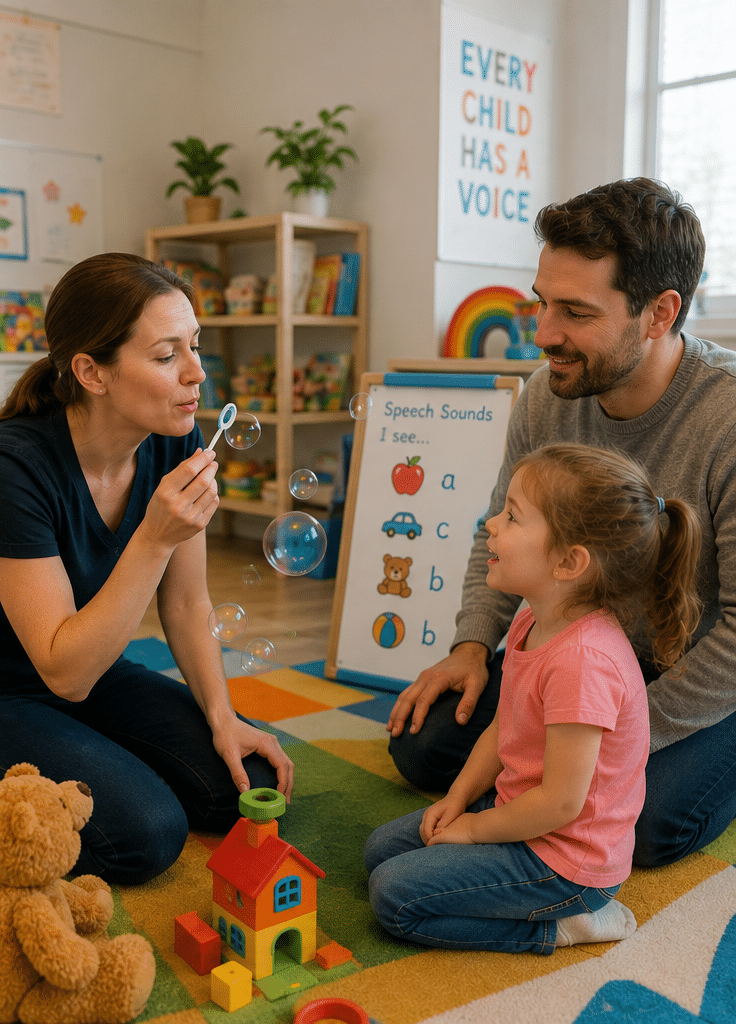
A pediatric speech pathologist helps children build the communication, speech, language, social, voice, fluency, and sometimes feeding or swallowing skills they need for daily life. In Canada, many families look for support when a child is hard to understand, not using many words, struggling at school, stuttering, or having trouble with social communication.
From my experience supporting families through speech and language questions, parents often arrive with the same concern: “Is my child just developing at their own pace, or should we get help?” That is a fair question. Children do grow differently. However, early guidance can reduce worry, clarify next steps, and help families practise useful strategies at home.
This guide explains what a pediatric speech pathologist does, when to seek help, how assessment works, what therapy may look like, and what Canadian families should know before booking services.
Table of Contents
- What Is a Pediatric Speech Pathologist?
- Definition
- Why Pediatric Speech Therapy Matters
- What Pediatric Speech Pathologists Help With
- Speech, Language, and Communication: What’s the Difference?
- When Should Parents Seek Support?
- Pediatric Speech Pathologist vs Other Child Professionals
- Public vs Private Pediatric Speech Services in Canada
- What Happens During an Assessment?
- Numbered Checklist: How to Prepare for a First Visit
- What Therapy May Look Like
- How Parents Can Support Progress at Home
- Canadian Regulation, Credentials, and Administrative Notes
- People Also Ask
- Expert Q&A
- Conclusion
What Is a Pediatric Speech Pathologist?
A pediatric speech pathologist is a regulated health professional who works with infants, toddlers, preschoolers, school-aged children, and teens. In Canada, the professional title is often “speech-language pathologist,” or SLP. Some families also use terms like speech therapist, speech pathologist, child speech therapist, or pediatric SLP.
The word “pediatric” simply means the professional focuses on children. As a result, care is adapted to a child’s age, developmental stage, learning style, culture, language background, and daily routines.
According to the Canadian Institute for Health Information, speech-language pathologists identify, diagnose, and treat communication and swallowing disorders across the lifespan. For children, that can include early words, sentence development, pronunciation, understanding language, social communication, stuttering, voice concerns, and feeding or swallowing support when it falls within the clinician’s scope and training.
In practice, pediatric speech therapy is not just about “fixing sounds.” It is about helping a child communicate more clearly and confidently at home, daycare, school, and in the community.
Definition
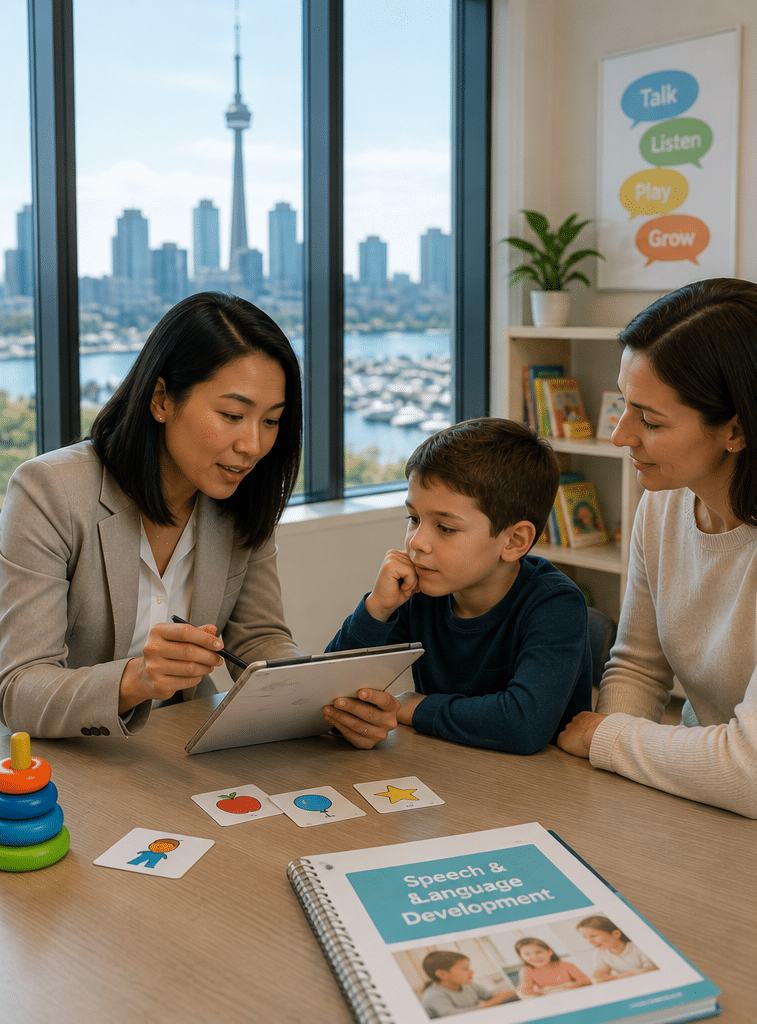
A pediatric speech pathologist is a speech-language pathologist who assesses and treats children with speech, language, communication, social interaction, fluency, voice, and sometimes feeding or swallowing concerns. In Canada, they work with families, educators, and health teams to support functional communication in everyday childhood routines.
Why Pediatric Speech Therapy Matters
Communication affects almost every part of a child’s life. It helps children ask for help, share ideas, make friends, follow classroom instructions, tell stories, and express feelings. Therefore, when communication is difficult, a child may become frustrated, withdrawn, or misunderstood.
Early support matters because children learn through repeated, meaningful interactions. For example, a toddler who is not yet using many words may benefit from parent coaching. A preschooler who is hard to understand may need help learning sound patterns. Likewise, a school-aged child who struggles with language may need support understanding stories, explaining ideas, or following multi-step directions.
A pediatric speech pathologist looks beyond the surface concern. Instead of asking only, “Can the child say this sound?” they may also ask:
- Can the child understand what others say?
- Can they use words, gestures, signs, pictures, or a device to communicate?
- Can they participate in play, routines, and learning?
- Are there hearing, developmental, motor, sensory, or medical factors?
- What strategies are already helping at home or school?
This broader view is important. A child may have clear speech but poor language understanding. Another child may understand well but have trouble producing certain sounds. Another may know what they want to say but stutter, avoid talking, or become anxious. Because of this, therapy should be based on a careful assessment, not guesswork.
What Pediatric Speech Pathologists Help With
A pediatric speech pathologist may support many childhood communication needs. The exact service depends on the clinician’s training, the child’s profile, and provincial or territorial practice rules.
Common areas include:
Speech Sound Difficulties
Some children are hard to understand because they substitute, omit, or distort sounds. For instance, a child may say “tat” for “cat,” leave off final sounds, or have trouble with sounds such as /r/, /s/, /l/, “sh,” or “th.”
A pediatric speech pathologist identifies whether the pattern is age-appropriate, delayed, or unusual. Then they choose therapy targets that can improve overall intelligibility.
Language Delay or Language Disorder
Language includes understanding words and sentences, using vocabulary, combining words, following directions, telling stories, and using grammar. A child with language difficulties may use fewer words than expected, struggle to answer questions, or have trouble explaining what happened.
Importantly, language is not the same as intelligence. Many children with language challenges are bright but need help processing and expressing information.
Early Communication
For infants and toddlers, therapy may focus on gestures, joint attention, imitation, play, turn-taking, early sounds, and first words. In many cases, the parent or caregiver is the most important therapy partner because communication learning happens throughout the day.
Stuttering and Fluency
Stuttering may include repetitions, stretched sounds, blocks, tension, or avoidance. Some young children go through brief periods of disfluency. However, if stuttering continues, becomes tense, or causes distress, a pediatric speech pathologist can assess risk factors and guide treatment.
Social Communication
Some children need help using language socially. They may struggle with turn-taking, flexible conversation, reading non-verbal cues, making inferences, or adjusting communication for different people and settings. This support can be relevant for autistic children, children with ADHD, and children with social-pragmatic language difficulties.
Voice Concerns
A child with a hoarse, strained, very quiet, or unusual voice may benefit from assessment. Voice therapy often involves education, healthy voice habits, and collaboration with medical providers when needed.
Feeding and Swallowing Concerns
Some SLPs support pediatric feeding and swallowing, also called pediatric dysphagia. This area requires specific training and often involves collaboration with physicians, dietitians, occupational therapists, nurses, and other health professionals. Speech-Language & Audiology Canada’s scope of practice for speech-language pathology includes communication and swallowing-related professional activities, while also recognizing that clinicians may limit practice by age, disorder, or interest.
Speech, Language, and Communication: What’s the Difference?
Parents often use “speech” to mean all talking. However, professionals use more specific terms. This matters because the right therapy plan depends on the real source of the difficulty.
| Area | What It Means | Possible Signs | Example Support |
| Speech | How sounds are produced | Child is hard to understand or says sounds incorrectly | Practising sound patterns in words, phrases, and conversation |
| Language | Understanding and using words, sentences, and stories | Child uses few words, struggles with directions, or has trouble explaining ideas | Building vocabulary, grammar, comprehension, and storytelling |
| Communication | The full process of sharing messages | Child struggles to request, comment, take turns, or interact | Using words, gestures, visuals, signs, or communication devices |
| Fluency | Smoothness of speech | Child repeats sounds, blocks, or avoids speaking | Stuttering assessment, fluency strategies, confidence support |
| Voice | Vocal quality, pitch, loudness, and effort | Hoarse, strained, or weak voice | Healthy voice strategies and referral when needed |
| Feeding/Swallowing | Safety and comfort with eating and drinking | Coughing, choking, limited textures, stressful meals | Assessment and team-based feeding support |
This distinction also helps families ask better questions. For example, “My child talks a lot but no one understands them” points toward speech sound concerns. In contrast, “My child says words clearly but cannot follow directions” points more toward language comprehension.
When Should Parents Seek Support?
Parents do not need to wait until a child “fails” before asking for help. In fact, a pediatric speech pathologist can often provide useful guidance even when the answer is reassurance and monitoring.
Consider seeking support if a child:
- Uses very few words compared with peers
- Stops using words or skills they had before
- Is hard for familiar people to understand
- Is frustrated because they cannot communicate
- Does not seem to understand simple directions
- Rarely gestures, points, imitates, or shares attention
- Stutters for several months or shows tension while speaking
- Has a hoarse or strained voice that does not improve
- Has feeding or swallowing concerns
- Struggles with conversation, stories, or classroom language
- Has communication needs linked to autism, ADHD, hearing loss, cleft palate, developmental delay, or neurological conditions
However, every child is different. Bilingual and multilingual children, including many children in Canadian homes, may distribute their vocabulary across languages. Therefore, a child should not be considered delayed simply because they use two or more languages. A good assessment considers all languages the child uses, family context, and cultural communication patterns.
Pediatric Speech Pathologist vs Other Child Professionals
Families often meet several professionals, and the roles can feel confusing. The table below shows how a pediatric speech pathologist may differ from other supports.
| Professional | Main Focus | When They May Be Involved |
| Pediatric speech pathologist | Communication, speech, language, fluency, voice, and sometimes feeding/swallowing | Child has speech, language, social communication, stuttering, or feeding concerns |
| Audiologist | Hearing and balance | Child has hearing concerns, repeated ear infections, or unclear hearing test results |
| Occupational therapist | Daily activities, sensory processing, fine motor, feeding participation | Child struggles with self-care, sensory needs, handwriting, or mealtime routines |
| Psychologist | Learning, behaviour, mental health, development | Child needs assessment for learning, attention, mood, or developmental profile |
| Pediatrician or family doctor | Medical health and referrals | Child needs medical evaluation, developmental monitoring, or specialist referral |
| Teacher or early childhood educator | Learning and participation in education settings | Child needs classroom strategies, learning support, or school-based observations |
In many cases, the best support is collaborative. For example, a child with feeding concerns may need both an SLP and an occupational therapist. A child with suspected hearing loss may need an audiology assessment before speech therapy targets are finalized. As a result, families should expect teamwork, not isolated care.
Public vs Private Pediatric Speech Services in Canada
Canadian families may access pediatric speech services through public programs, schools, hospitals, community health services, or private clinics. Availability varies by province, region, age, diagnosis, and referral pathway.
| Option | Possible Benefits | Possible Limits | Good Fit For |
| Public health or community programs | Lower direct cost, local referral pathways, team-based services | Waitlists may be long; eligibility may vary | Families seeking publicly funded early support |
| School-based services | Connects therapy goals with classroom needs | Service intensity may depend on school board resources | School-aged children with learning participation needs |
| Hospital-based programs | Useful for complex medical, feeding, swallowing, or developmental needs | Usually requires referral and specific eligibility | Children with medical or specialized care needs |
| Private pediatric speech pathologist | More scheduling control, direct parent involvement, individualized frequency | Out-of-pocket cost unless covered by benefits | Families wanting timely assessment or extra therapy |
| Virtual speech therapy | Convenient for some families, especially rural or busy households | Not ideal for every child or concern | Parent coaching, language therapy, some speech goals |
Neither public nor private service is automatically “better.” Instead, the right option depends on the child’s needs, wait times, goals, family preferences, and available funding. Some families use both, when appropriate.
For families exploring private support, Speech For All’s child-focused communication services can help parents understand next steps and choose support that fits their child’s daily life.
What Happens During an Assessment?
A pediatric speech pathologist assessment is usually friendly, play-based, and practical. It may look different depending on the child’s age and concerns.
For toddlers, the SLP may watch play, gestures, sounds, word use, interaction, and caregiver-child communication. For preschoolers, they may use pictures, toys, stories, and simple tasks. For school-aged children, they may assess grammar, vocabulary, comprehension, narrative language, speech sounds, reading-related language, or social communication.
An assessment may include:
- Parent or caregiver interview
- Review of developmental and medical history
- Hearing history questions
- Observation of play or conversation
- Standardized tests, when suitable
- Informal language sampling
- Speech sound assessment
- Oral-motor or voice screening, if relevant
- Feeding observation, if within the referral concern
- Discussion of strengths, needs, and recommendations
The “why” behind assessment is simple: therapy should target the skills that matter most. Without assessment, a child may practise the wrong goals. For example, a child who says few words may need help with interaction and language, not just sound imitation. Meanwhile, a child with many words but unclear speech may need a speech sound plan.
How to Prepare for a First Visit
Use this checklist before meeting a pediatric speech pathologist:
- Write down your main concerns in plain language.
For example, “Grandparents cannot understand him,” or “She gets upset when we do not know what she wants.” - List your child’s strengths.
Include what they enjoy, how they play, favourite toys, favourite people, and what already helps. - Gather relevant documents.
Bring hearing test results, medical reports, school notes, daycare observations, or previous assessments if available. - Note language exposure.
Write which languages your child hears and uses, who speaks each language, and where they use them. - Track examples for one week.
Write down words, phrases, stutters, unclear sounds, or situations that show the concern. - Prepare questions.
Ask about goals, home practice, expected therapy frequency, parent involvement, and how progress will be measured. - Bring comfort items.
For young children, a favourite toy or snack may help the clinician observe natural communication. - Stay open to coaching.
Pediatric therapy often works best when caregivers learn strategies they can use during daily routines.
What Therapy May Look Like
Therapy should not feel like a child sitting through a lecture. Instead, a pediatric speech pathologist usually builds goals into play, books, conversation, movement, games, routines, or school-like tasks.
For a toddler, therapy may involve parent coaching during play. The SLP might show caregivers how to pause, model simple words, offer choices, imitate the child, and expand communication attempts.
For a preschooler with speech sound difficulties, therapy may include listening activities, mouth placement cues, practice words, and fun repetition. However, the goal is not only to say a sound once. The goal is to use clearer speech in real conversation.
For a school-aged child with language needs, therapy may include vocabulary learning, sentence formulation, story structure, listening comprehension, explaining ideas, or understanding figurative language. These skills can support classroom participation.
For a child who stutters, therapy may focus on reducing struggle, improving confidence, supporting easier communication, and helping caregivers respond in ways that reduce pressure.
For a child who uses augmentative and alternative communication, or AAC, therapy may involve pictures, communication boards, speech-generating devices, gestures, signs, or a mix of methods. Importantly, AAC does not mean giving up on speech. Instead, it gives the child a reliable way to communicate while speech and language continue developing.
How Parents Can Support Progress at Home
Parents do not need to become therapists. However, they do play a major role. Children make progress when strategies are simple, repeated, and connected to real life.
Here are practical examples:
- During meals, model words like “more,” “all done,” “hot,” “crunchy,” and “help.”
- During play, follow the child’s lead before adding language.
- During book reading, comment more and quiz less.
- During dressing, use short phrases like “sock on,” “zip up,” and “arms in.”
- During car rides, talk about what you see.
- During frustration, model useful phrases such as “help me,” “my turn,” or “I don’t like it.”
In my experience, families often feel relieved when they learn that home practice does not need to be long. Five minutes of focused, warm interaction can be more useful than a forced half-hour drill. Consistency matters more than perfection.
Canadian Regulation, Credentials, and Administrative Notes
In Canada, speech-language pathology is regulated provincially in most jurisdictions. That means requirements can differ depending on where the clinician practises. Speech-Language & Audiology Canada lists provincial regulatory bodies for audiology and speech-language pathology, and families can use those regulators to confirm registration requirements in their province.
For example, Ontario has the College of Audiologists and Speech-Language Pathologists of Ontario. Other provinces have their own colleges or regulatory bodies. These organizations are designed to protect the public by setting registration, standards, and conduct expectations.
For families, this is mainly an administrative point. It is not legal advice. Before starting therapy, parents can ask:
- Are you registered to practise in this province?
- Do you work mainly with children?
- What age groups and concerns do you commonly support?
- Do you offer parent coaching?
- How do you measure progress?
- Do you provide reports for schools, physicians, or funding programs?
- What fees, cancellation policies, and documentation are involved?
If a family is using insurance or health spending benefits, they may also need receipts with the clinician’s name, credentials, registration number, and service date. These are administrative details, but they can prevent confusion later.
People Also Ask
What does a pediatric speech pathologist do?
A pediatric speech pathologist assesses and treats children with communication, speech, language, stuttering, voice, social communication, and sometimes feeding or swallowing concerns. They also coach parents and collaborate with teachers, doctors, and other professionals when needed.
When should my child see a pediatric speech pathologist in Canada?
A child should see a pediatric speech pathologist if they are hard to understand, use fewer words than expected, struggle to follow directions, stutter with tension, lose communication skills, or become frustrated when trying to communicate. Parents can also seek guidance if they simply feel unsure.
Is a pediatric speech pathologist the same as a speech therapist?
In everyday conversation, many families say speech therapist. In Canada, the professional title is usually speech-language pathologist. A pediatric speech pathologist is an SLP who focuses on children.
Can a pediatric speech pathologist help a bilingual child?
Yes. A bilingual child can be assessed with attention to all languages they hear and use. Speaking more than one language does not cause a language disorder, so the assessment should consider the child’s full communication environment.
Do I need a doctor’s referral for pediatric speech therapy?
It depends on the service pathway. Some public, hospital, or funded programs may require referrals, while many private clinics allow families to contact them directly. Requirements vary across Canada, so families should check the specific program or provider.
Expert Q&A
1. How long does pediatric speech therapy take?
It depends on the child’s needs, age, goals, practice opportunities, and consistency. Some children need a few sessions of parent coaching, while others benefit from longer-term support. A pediatric speech pathologist should review progress regularly and adjust goals as needed.
2. What should I do if my toddler is not talking yet?
Start by observing how your toddler communicates overall. Do they point, gesture, imitate, understand words, make sounds, and try to share attention? If spoken words are limited or communication feels frustrating, a pediatric speech pathologist can assess early communication and show you strategies to use during play and routines.
3. Will my child grow out of speech sound errors?
Some sound errors are common at certain ages. However, persistent errors, reduced intelligibility, unusual sound patterns, or frustration may need support. An assessment can help determine whether the pattern is developmental or whether therapy would be useful.
4. Can speech therapy help with school success?
Yes, especially when language skills affect listening, vocabulary, grammar, storytelling, reading comprehension, writing, or classroom participation. A pediatric speech pathologist may support the language foundations that help children understand lessons and express what they know.
5. What makes a good pediatric speech pathologist?
A good pediatric speech pathologist uses evidence-informed care, explains goals clearly, involves caregivers, respects the child’s personality, and adapts therapy to real-life needs. They should also communicate honestly about progress, limits, and when other referrals may be helpful.
Conclusion
A pediatric speech pathologist can help children communicate more clearly, confidently, and comfortably in everyday life. In Canada, SLPs support a wide range of needs, from first words and speech sounds to school language, stuttering, social communication, voice, and feeding or swallowing concerns.
The best first step is not to panic or wait indefinitely. Instead, gather observations, ask questions, and seek an assessment when concerns affect your child’s daily communication. With the right support, families can better understand what is happening, why it matters, and how to help.
Tags: pediatric speech pathologist, pediatric speech pathologist degree, pediatric speech pathologist education, pediatric speech pathologist how to become, pediatric speech pathologist jobs, pediatric speech pathologist jobs near me, pediatric speech pathologist near me, pediatric speech pathologist requirements, pediatric speech pathologist salary, pediatric speech pathologist schooling