

Table of Contents
- Introduction
- Definition
- What a Speech Pathologist for Toddlers Actually Does
- When Should a Toddler See a Speech Pathologist?
- Speech, Language, and Communication: What Is the Difference?
- Common Reasons Canadian Families Seek Toddler Speech Therapy
- What Happens During a Toddler Speech Assessment?
- Onshore, Virtual, and Public Services in Canada: Comparison Table
- A Numbered Checklist for Getting Started
- How Parents Can Support Speech at Home
- People Also Ask
- Expert Q&A Section
- Conclusion
Introduction
Finding a speech pathologist for toddlers can feel stressful when your child is not talking as much as other children, uses only a few words, or becomes frustrated when trying to communicate. Many parents in Canada wonder whether their toddler is simply a “late talker” or whether early support would help. That question matters because toddler communication affects everyday routines, play, daycare, family connection, safety, and later learning.
From my experience working with family-focused communication content, parents usually do not want a complicated clinical lecture. They want clear signs to watch for, a fair explanation of what therapy involves, and practical next steps that make sense in a Canadian setting. This guide explains what a speech-language pathologist does, when to seek help, what assessment may look like, and how families can support speech and language at home.
In Canada, speech-language pathologists are trained health professionals who assess and treat communication and swallowing disorders across the lifespan. According to Speech-Language & Audiology Canada, speech-language pathologists help with speech delays and disorders, language difficulties, voice, fluency, social communication, and related needs. For toddlers, that support is often playful, parent-centred, and built into daily routines.
Definition
A speech pathologist for toddlers is a trained communication professional who assesses and supports young children with speech sounds, first words, understanding language, social communication, feeding, or early interaction concerns. In Canada, they guide families with practical strategies, therapy plans, and referrals when hearing, development, or medical factors may be involved.
What a Speech Pathologist for Toddlers Actually Does
A speech pathologist for toddlers, also called a speech-language pathologist or S-LP, helps families understand how a child communicates and what may be getting in the way. For toddlers, communication is more than saying words. It includes eye contact, gestures, pointing, turn-taking, understanding simple directions, imitation, play, sound use, and attempts to share needs.
A toddler may need help with expressive language, which means using words, signs, sounds, or gestures to communicate. Another toddler may need help with receptive language, which means understanding words, routines, questions, and directions. Some children need support with speech sound development, such as making sounds clearer. Others may need help with social communication, play skills, or feeding-related communication.
A good toddler speech pathologist does not simply “drill words.” Instead, they observe the whole child. They ask how your toddler communicates at home, daycare, and in the community. They also ask about hearing, medical history, languages spoken at home, family concerns, and daily routines.
For example, a child who says only five words at age two may still communicate through gestures, pointing, and sounds. Another child may say many words but not understand simple instructions. A third child may talk at home but not at daycare. Because each pattern is different, the therapy plan should be individual.
The “why” behind early support is simple: toddlers learn communication through repeated, meaningful interaction. Therefore, therapy often teaches parents how to create more communication opportunities during meals, dressing, bath time, outdoor play, book sharing, and pretend play.
When Should a Toddler See a Speech Pathologist?
Parents should consider a speech pathologist for toddlers when a child is not meeting expected communication milestones, loses skills, seems frustrated by communication, or is hard for familiar adults to understand. However, milestones are guides, not strict pass-or-fail tests. Children develop at different rates, and bilingual children may divide words across languages.
Still, it is wise to ask for help early when concerns persist. According to MyHealth.Alberta.ca, many children use at least 50 words and begin combining two-word phrases around 24 months, while also noting that development varies from child to child. This means a toddler does not need to match every milestone perfectly, but a large gap can be a reason to check in.
You may want to contact a speech-language pathologist, family doctor, nurse practitioner, public health nurse, or local preschool speech and language program if your toddler:
- Is not using gestures such as pointing, waving, or showing objects.
- Does not seem to understand common words or simple directions.
- Has very few words by age two.
- Does not combine words by around age two.
- Uses words but is very hard to understand.
- Rarely imitates sounds, actions, or words.
- Shows frustration, biting, screaming, or withdrawing when not understood.
- Has a history of frequent ear infections or suspected hearing difficulty.
- Stops using words or social skills they previously had.
From my experience, parents often wait because they hope the child will “grow out of it.” Sometimes children do catch up. However, an assessment does not label a child forever. Instead, it gives parents information. In many cases, that information lowers stress because the family gets a clear plan.
Speech, Language, and Communication: What Is the Difference?
Understanding basic terms helps parents have better conversations with professionals.
Speech means the physical production of sounds. It includes articulation, sound patterns, clarity, voice, and fluency. For example, a toddler who says “tat” for “cat” may be showing a speech sound pattern that is common at certain ages. However, if many sounds are missing or the child is very difficult to understand, a speech pathologist may assess speech sound development.
Language means understanding and using words, sentences, and meaning. Receptive language is what a child understands. Expressive language is what a child communicates. For example, a toddler who understands “get your shoes” but says few words may have different needs than a toddler who talks but does not follow simple directions.
Communication is the broadest term. It includes speech, language, gestures, facial expressions, body language, play, attention, and social interaction. A toddler can communicate before they speak. Pointing to a banana, pulling a parent toward the fridge, handing over a toy, or saying “uh-oh” all count as communication.
This matters because therapy for toddlers often begins with communication, not perfect words. A speech pathologist for toddlers may first help a child take turns, imitate actions, request help, make choices, and share attention. As a result, spoken language may have a stronger foundation.
Common Reasons Canadian Families Seek Toddler Speech Therapy
Families across Canada seek toddler speech therapy for many reasons. Some concerns are mild and short-term. Others are part of broader developmental or medical needs. A balanced approach avoids panic while still taking concerns seriously.
Late Talking
Late talking is one of the most common reasons parents look for a speech pathologist for toddlers. A late-talking toddler may understand much of what is said but use fewer spoken words than expected. Some late talkers catch up, while others continue to need support. Because it is hard to predict which path a child will take, early guidance can be useful.
A speech-language pathologist may look at gestures, play, imitation, understanding, sound variety, family history, and frustration level. These details help determine whether parent coaching, direct therapy, monitoring, or another referral is appropriate.
Unclear Speech
Toddlers are not expected to sound like adults. However, familiar adults should gradually understand more of what the child says. If a toddler uses many sounds incorrectly, leaves off syllables, or is understood only by close family, an assessment may help.
The pathologist may check whether speech patterns are age-expected or whether the child needs support with sound production, motor planning, or hearing-related factors.
Difficulty Understanding Language
Some toddlers say words but struggle to understand. They may not follow simple directions, respond to their name, identify common objects, or understand everyday routines. This can be missed because adults often use gestures and context. For example, a child may go to the door when everyone is putting on coats, but may not understand the words “get your shoes” without visual clues.
Because understanding supports learning, behaviour, and safety, receptive language concerns deserve attention.
Bilingual or Multilingual Development Questions
Many Canadian families use more than one language at home. Bilingualism does not cause speech or language disorders. However, multilingual development can make parents unsure how to count words or interpret milestones.
A toddler’s total communication across languages matters. For instance, “milk” in English and “lait” in French may count as two words if the child uses both meaningfully. A culturally responsive speech pathologist will ask about all languages and will not tell families to drop a home language without a clear clinical reason.
Social Communication and Play Concerns
Some toddlers use words but rarely share attention, imitate, point to show interest, or engage in pretend play. Others prefer repetitive play or seem less responsive to people. These concerns do not automatically mean one diagnosis. However, they can be important signals.
A speech pathologist may support social communication and may also recommend follow-up with a physician, psychologist, occupational therapist, audiologist, or developmental team if broader assessment is needed.
Feeding or Swallowing Concerns
Some speech-language pathologists also work with feeding and swallowing. A toddler with coughing during meals, extreme texture refusal, poor chewing, or suspected swallowing difficulty may need a specialized assessment. In these cases, families should also speak with their primary care provider because feeding and swallowing can involve medical risk.
What Happens During a Toddler Speech Assessment?
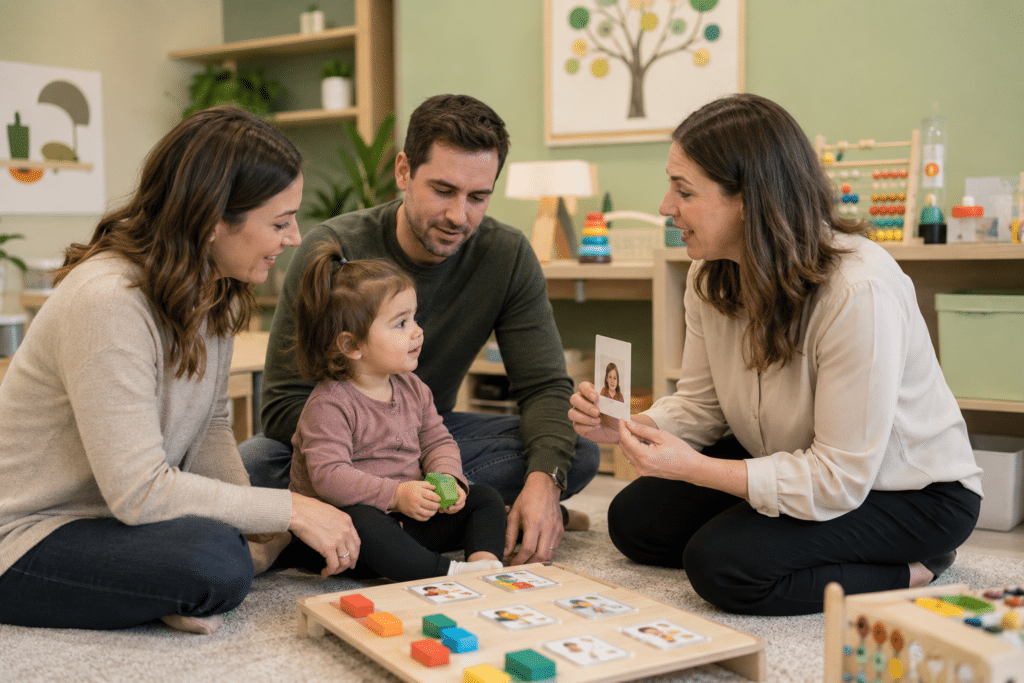
A toddler speech assessment is usually friendly, play-based, and parent-centred. It may happen in a clinic, home, daycare, school-readiness program, hospital setting, or online depending on the service.
First, the speech pathologist asks about your concerns. They may ask when your child first babbled, used words, combined words, followed directions, pointed, played with others, or responded to sound. They may also ask about pregnancy and birth history, medical diagnoses, ear infections, hearing tests, daycare reports, languages spoken at home, and family history.
Next, the pathologist observes your toddler. They may use toys, books, bubbles, pretend food, puzzles, blocks, or routine-based activities. Although it looks like play, the clinician is watching important skills. These may include eye contact, joint attention, turn-taking, imitation, sound use, word use, comprehension, gestures, play level, and frustration tolerance.
Then, the pathologist may use formal or informal assessment tools. Formal tools compare a child’s skills to age expectations. Informal tools may include language samples, parent questionnaires, observation, and caregiver interviews. For toddlers, informal observation can be especially helpful because young children may not perform naturally in a structured test.
Finally, you should receive feedback in plain language. A helpful summary explains what your child is doing well, what needs support, and what the next steps are. These next steps may include therapy, parent coaching, hearing assessment, home strategies, daycare collaboration, or referral to another professional.
Onshore, Virtual, and Public Services in Canada: Comparison Table
Canadian families may access support through public programs, private clinics, virtual services, hospitals, or community agencies. Availability varies by province or territory, and wait times can change. Therefore, families should check local options.
| Service option | Best for | Possible benefits | Possible limits |
| Public preschool speech and language program | Families seeking publicly funded support | Lower direct cost, local pathway, often connected to community services | Wait times may vary; eligibility and age rules differ by region |
| Private in-person speech pathologist | Families wanting direct assessment or regular sessions | Faster access in some areas, hands-on play observation, parent coaching | Out-of-pocket cost unless covered by benefits |
| Virtual speech therapy | Families in rural areas, busy schedules, or parent-coaching models | Convenient, supports home routines, may reduce travel | Not ideal for every child or concern; requires parent participation |
| Hospital or specialized clinic | Children with medical, hearing, feeding, developmental, or complex needs | Team-based care, specialized assessment | Referral may be required; wait times may be longer |
| Daycare or community-based collaboration | Children whose concerns show up in group settings | Strategies can be used in real routines | Depends on provider availability and consent |
If you are unsure where to begin, start with your family doctor, nurse practitioner, local public health unit, or a registered speech-language pathologist. In Ontario, for example, families are often directed to local preschool speech and language programs when a young child is not meeting communication milestones. The Child Development Programs communication milestones resource also advises families to contact their local Preschool Speech and Language Program if milestones are not being met.
A Numbered Checklist for Getting Started
Use this checklist before booking a speech pathologist for toddlers.
- Write down your top concerns.
Note what your toddler says, understands, and does when they cannot communicate. - Track words and gestures for one week.
Include sounds, signs, animal noises, approximations, and words in every language your child uses. - Check hearing history.
Write down ear infections, failed hearing screens, concerns about response to sound, or family hearing history. - Ask daycare or caregivers what they notice.
Toddlers may communicate differently outside the home. - Contact a local public program or private S-LP.
Ask about wait times, assessment format, fees, parent involvement, and whether the clinician works with toddlers. - Confirm registration requirements.
In Canada, regulation is provincial. Ask whether the provider is registered with the appropriate provincial regulatory college where required. - Prepare for the first appointment.
Bring milestone notes, medical details, daycare comments, videos if helpful, and your main questions. - Ask for home strategies.
Toddler therapy works best when adults use strategies between sessions. - Review progress regularly.
Ask what changes to watch for over the next four to eight weeks. - Follow up if concerns expand.
If hearing, feeding, social communication, motor skills, or behaviour concerns appear, ask about referrals.
How Parents Can Support Speech at Home
Parents play a major role in toddler speech and language growth. This does not mean parents caused the delay. It means toddlers learn best through repeated practice with trusted adults.
Follow Your Toddler’s Lead
Start with what your child already enjoys. If your toddler loves cars, talk about cars. If they love water play, use words like “pour,” “splash,” “more,” “wet,” and “all done.” Because the child is already interested, communication has a purpose.
Following a child’s lead also reduces pressure. Instead of asking “What colour is this?” many times, try describing what is happening: “Big truck. It’s going up. Crash!” This gives the child useful language without turning play into a test.
Use Short, Clear Language
Toddlers benefit from language they can copy. If your child uses one word, model two-word phrases. For example, if your child says “ball,” you can say “big ball,” “roll ball,” or “ball go.” If your child uses no words yet, model simple sounds, gestures, and single words.
This approach works because it stays one step ahead of the child. It gives a reachable target rather than a sentence that is too long.
Create Communication Temptations
A communication temptation is a playful reason to communicate. For example, place a favourite snack in a clear container your child cannot open. Pause before blowing bubbles. Give one piece of a puzzle at a time. Offer a choice between two toys.
However, the goal is not to frustrate the child. The goal is to create a small pause where your toddler can look, point, reach, vocalize, sign, or say a word. Then respond warmly.
Expand What Your Child Says
If your toddler says “dog,” you can expand with “big dog,” “dog running,” or “brown dog.” If they say “more,” you can say “more crackers.” This shows your child how to build longer messages.
Expansions are powerful because they validate what the child said first. Instead of correcting, you build.
Read Books Interactively
Books are excellent for toddlers, but you do not need to read every word. Talk about pictures. Make animal sounds. Pause so your child can fill in a sound or action. Ask fewer test questions and make more comments.
For example, while reading a farm book, you might say, “Cow says moo,” “Uh-oh, pig is dirty,” or “Where’s baby?” Then wait. Your toddler may point, smile, vocalize, or say a word.
Reduce Screen-Only Learning
Digital media cannot replace responsive back-and-forth interaction. Some toddler videos teach songs or labels, but children still need live conversation, turn-taking, movement, and shared attention. Therefore, use screens carefully and prioritize face-to-face routines.
Support All Home Languages
If your family speaks Punjabi, Arabic, Mandarin, French, Tamil, Spanish, Tagalog, Cree, Urdu, or another language, keep using it. A strong home language supports family connection and cultural identity. Also, parents usually provide richer language in the language they know best.
If a speech pathologist for toddlers understands bilingual development, they will ask about the whole language environment rather than judging only English words.
Why Early Support Matters
Early support matters because toddler communication grows quickly. Small changes in adult interaction can create many learning moments each day. For example, if a parent uses a strategy during snack, bath, dressing, and play, the child may receive dozens of natural practice opportunities.
Early help can also reduce frustration. When toddlers cannot express needs, they may cry, pull, hit, bite, or shut down. These behaviours are often communication attempts. As the child gains more ways to request, refuse, comment, and ask for help, daily routines can become easier.
In addition, early support helps parents understand what is typical and what is not. Parents may blame themselves or feel judged. A good speech pathologist should replace blame with coaching, practical tools, and realistic goals.
What Goals Might Look Like in Toddler Speech Therapy
Therapy goals should match the child’s needs. They should also be functional, which means they help in real life.
Possible toddler goals include:
- Using gestures or signs to request help.
- Imitating actions during play.
- Making more speech sounds during routines.
- Using 10 new meaningful words.
- Combining two-word phrases such as “more milk” or “daddy go.”
- Following one-step directions without gestures.
- Taking turns during simple play.
- Using words or gestures instead of screaming to request.
- Improving speech clarity for common words.
- Increasing shared attention during books and play.
Good goals are not vague. For example, “improve speech” is broad. A clearer goal might be: “During snack and play routines, the child will use a word, sign, or gesture to request more in four out of five opportunities.” Clear goals help parents see progress.
How Long Does Toddler Speech Therapy Take?
There is no single timeline. Some toddlers need a few parent-coaching sessions and home strategies. Others need ongoing therapy for several months or longer. The timeline depends on the child’s profile, hearing, attention, understanding, motor speech skills, family practice, attendance, and whether other developmental needs are present.
Be cautious of anyone who guarantees results by a specific date. Progress can be strong, but it is not identical for every child. Instead, ask the speech pathologist how progress will be measured and when the plan will be reviewed.
A balanced plan may include short-term goals, home practice, follow-up assessment, and collaboration with daycare or other providers.
Cost, Insurance, and Access in Canada
Speech therapy access in Canada depends on province or territory, age, referral pathway, and service type. Some publicly funded preschool services may be available, but wait times and eligibility can vary. Private services usually involve fees, although some families may have coverage through extended health benefits, health spending accounts, or disability-related programs.
Before booking, ask:
- What is the cost of assessment?
- What is the cost per therapy session?
- Are receipts provided for insurance?
- Is a doctor’s referral needed for reimbursement?
- Does the clinician work with toddlers?
- Can sessions include parent coaching?
- Are virtual appointments available?
- What happens if my child does not participate during the session?
These are administrative questions, not legal advice. For insurance, tax, or funding decisions, families should confirm details with their benefit provider, accountant, public program, or licensed professional where appropriate.
How to Choose a Speech Pathologist for Toddlers
Choosing the right speech pathologist for toddlers is about fit, training, and trust. You want someone who understands early development and can explain strategies clearly.
Look for a provider who:
- Is qualified and registered where required in their province or territory.
- Has experience with toddlers and early language.
- Uses play-based and routine-based approaches.
- Welcomes parent involvement.
- Explains findings in plain language.
- Respects bilingual and multicultural families.
- Offers realistic goals, not guarantees.
- Collaborates with daycare, physicians, audiologists, or other professionals when needed.
You can also ask how they measure progress. A helpful answer might include parent reports, language samples, goal tracking, observation, and periodic review.
If you are looking for family-centred communication support, explore toddler speech and language services in Canada to learn how early guidance can help your child communicate with more confidence.
Red Flags That Need Prompt Attention
Some concerns should be discussed with a health professional promptly. These include loss of words, loss of social skills, limited response to sound, feeding or swallowing concerns, repeated choking, very limited eye contact with communication concerns, or no gestures by the second year of life.
A speech pathologist may be part of the support team, but they may not be the only professional involved. For example, suspected hearing issues should be checked by an audiologist or appropriate hearing service. Broader developmental concerns may involve a physician, psychologist, occupational therapist, or developmental paediatric team.
The key point is not to panic. Instead, act early and gather information.
People Also Ask
1. What age should a toddler see a speech pathologist in Canada?
A toddler can see a speech pathologist as soon as parents or caregivers have concerns. You do not need to wait until school age. Early assessment can clarify whether your child needs therapy, monitoring, hearing follow-up, or parent strategies.
2. Is it normal for a two-year-old not to talk much?
Some two-year-olds talk later than others, but very few words or no two-word combinations can be a reason to seek advice. A speech pathologist for toddlers can look at understanding, gestures, play, sound use, and family history to decide whether support is needed.
3. Can bilingual toddlers have speech delay?
Bilingualism itself does not cause speech delay. However, bilingual toddlers can still have speech or language disorders, just like monolingual toddlers. A proper assessment should consider all languages your child hears and uses.
4. Do I need a doctor’s referral for toddler speech therapy?
It depends on the service. Some public programs or insurance plans may require a referral, while many private speech-language pathologists accept direct contact from parents. Always check local program rules and your benefit plan.
5. What happens if my toddler will not sit for therapy?
That is common. Toddler therapy should not depend on sitting at a table for long periods. A skilled speech pathologist uses play, movement, routines, parent coaching, and short activities to match the child’s developmental stage.
Expert Q&A Section
1. What should I bring to a toddler speech assessment?
Bring a list of your concerns, words your child uses, languages spoken at home, medical history, hearing information, daycare notes, and any previous reports. Short videos of your child communicating at home can also help because toddlers may act differently in a clinic.
2. How can I tell if my toddler understands language?
Watch how your child responds without extra clues. For example, say “bring me your shoes” when you are not pointing or standing near the door. If your toddler often needs gestures, routines, or guessing, a speech pathologist may want to assess receptive language.
3. Will speech therapy make my toddler talk right away?
Speech therapy can help, but it does not guarantee instant talking. Many toddlers first improve attention, imitation, gestures, sounds, turn-taking, or understanding. These early gains often support later word growth.
4. Should I correct my toddler’s pronunciation?
Gentle modelling is usually better than constant correction. If your child says “tar” for “car,” you can respond, “Yes, car. Fast car!” This keeps communication positive while giving the correct model.
5. How often should we practise speech strategies at home?
Short, frequent practice works best. Instead of one long lesson, use strategies during daily routines such as meals, dressing, books, bath time, and play. A speech pathologist for toddlers can show you how to practise without making the day feel like therapy.
Conclusion
A speech pathologist for toddlers can help Canadian families understand early communication, identify delays, and build practical strategies for daily life. The best support is clear, realistic, and family-centred. It looks at the whole child, including speech, language, gestures, play, hearing, routines, and social connection.
If your toddler is not using many words, is hard to understand, struggles to follow simple directions, or becomes frustrated when communicating, it is reasonable to ask for help. Early guidance does not mean something is “wrong” with your child. It means you are giving your child more ways to connect, learn, and be understood.
The next step is simple: write down your concerns, check your local options, and speak with a qualified speech-language pathologist who works with toddlers. With the right plan, parents can turn everyday moments into powerful communication opportunities.
Tags: speech language pathologist for toddlers near me, speech language therapy for toddlers, speech pathologist for kids, speech pathologist for kids near me, speech pathologist for toddlers, speech pathologist for toddlers near me, speech therapist for toddlers, speech therapist for toddlers cost, speech therapist for toddlers near me, speech therapist for toddlers salary